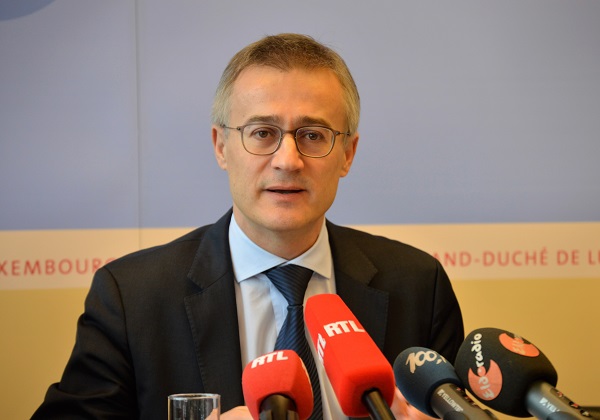
On Monday 14 March 2016, Luxembourg's Minister of Justice, Félix Braz, presented the new version of the nationality bill to replace the Act of 23 October 2008 and the law of 7 June 1989, stating that this reform in legislation will aim to reaffirm Luxembourg's image as an "open country".
The draft law was agreed by the Cabinet in October 2015, and was followed by a voluntary period of consultation with the main two parliamentary opposition parties. The language conditions remain, with a candidate required to show an A2 level of Luxembourgish oral expression and a B1 level of comprehension; the levels are according to the Cadre européen commun de référence pour les langues (CECRL).
An understanding of Luxembourg's history and state institutions, etc., will also be requested, through a civics course and exam based on "Vivre ensemble au Grand-Duché de Luxembourg". This course will be comprised of a total of 24 hours of classes, divided into the three modules of the fundamental rights of citizens (six hours); the state and communal institutions of the Grand Duchy of Luxembourg; and the history of the Grand Duchy and its European integration. Individuals, however, who already hold this knowledge and do not believe they need to take the classes will be allowed to directly take the exam.
The new legislation has also brought back an aspect that was abolished in the law of 2008, that of a simplified procedure for acquiring Luxembourg nationality, offered to those matching any of the following criteria:
- An individual born in Luxembourg who, from the age of 12, may apply for Luxembourgish nationality as long as they have lived continuously in the country for five consecutive years prior to the application and that one of their non-Luxembourgish parents has lived for at least 12 consecutive months in the Grand Duchy;
- An individual married to a Luxembourg national, who has grasped the Luxembourgish language and passed the exam as well as the civics course, as well as having been together with their spouse for at least three consecutive years immediately preceding the application;
- An adult (of legal voting age, i.e. 18+ years) who has spent at least seven years in a Luxembourgish public or private school based on the Luxembourgish education system, so long as they have been legally residing in the country for at least twelve consecutive months prior to the application;
- A long-term resident of Luxembourg who has been living in the country for at least twenty years, on the condition that they participate in 24 hours of Luxembourgish language classes organised by the Institut national des langues (INL);
- An individual holding the status of a stateless person, refugee or of subsidiary protection who has been living in Luxembourg for at least five years, and has passed the language and civics exams;
- A voluntary soldier who has been certified by the Chief of Staff of the Luxembourg Army to have dedicated at least one year of service
- An adult whose parent possesses or has possessed Luxembourgish nationality but who has never obtained Luxembourgish nationality;
- The parent of a Luxembourg national, so long as the applicant has lived continuously in the Grand Duchy for at least five years and has passed the language and civics exam;
- A candidate who has completed the obligations set out under the "contrat d'accueil et d'Intégration" (CAI), who has lived in Luxembourg for at least five years; who has passed the language exam and has either participated in the civics course or passed the relevant test;
- A candidate who immigrated to the Grand Duchy before reaching the adult age (18) and who has lived in the country for at least five years, has proven to have an understanding of the Luxembourgish language through the required exam, and has either participated in the civics course or passed the relevant test.
Speaking to The Luxembourg Chronicle, Minister Braz described the legislation as "an accurate answer to the specific situation of Luxembourg".
"That's what we intended to do and that's what we achieved I believe and we did that together with two of the three opposition parties which was the objective of those negotiations that I started back in November and I’m very glad that we managed to have that kind of broad consensus in Luxembourg," the Minister added. "You remember the episode of the referendum last year which was I think partly, wrongly, interpreted as a signal that Luxembourg was no longer an open country to the rest of the world. This proves the opposite. We still are an open country. That is why we have 46% of non-Luxembourgers."
The new law is expected to be implemented on 1 January 2017.
Photo by Sarah Graham (Félix Braz)