Ahead of International Women's Day taking place on 8 March 2016, Luxembourg's statistics portal STATEC has published a report on the lives of women in the Grand Duchy.
International Women's Day arose from the struggle workers in North America and Europe faced in the early 20th century to acquire the same rights, such as the right to vote and better working conditions, that had already been granted to men. The United Nations first celebrated International Women's Day on 8 March 1975 and, two years later, the General Assembly adopted a resolution proclaiming that a United Nations Day for women's rights and international peace must be celebrated by Member States on a day of the year of their choosing, according to their own historical and national traditions.
The UN slogan for this year's Day is 'Pledge for Parity', whilst in the Grand Duchy, the Journée International des Femmes (JIF2016) action platform has retained the unifying theme of 'Images of Women', which it claimed are rewarding, diverse, pluralistic and realistic.
As of 1 January 2015, 280,986 women were found to reside in Luxembourg, constituting 49.9% of the overall resident population. Whereas previously women represented the majority, this changed in 2014 when the number of men became slightly higher. There are more Luxembourgish women than Luxembourgish men, although this trend is reversed for individuals of foreign nationality. STATEC attributed this to greater tendencies in international male migration.
In 2014, women aged 30 to 34 were found more likely to complete higher education than men of the same age group, at 55% against 49.8%, although the employment rate for female 20 to 64 year olds in the same year was lower, at 64.9%, than for the male demographic, at 77.7%. The latter aspect however reflects a continuous increase for women since 2000, when the female employment rate stood at only 53.8%.
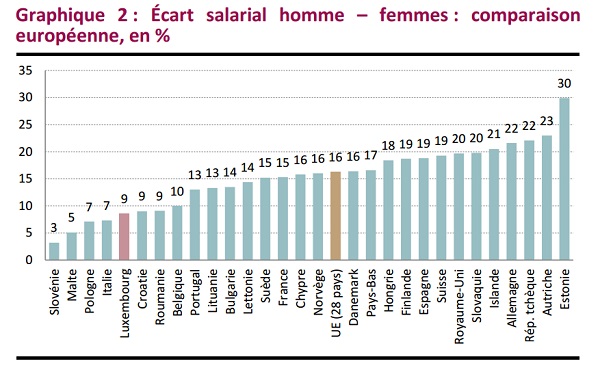
Women continue to earn less than men in Luxembourg, with the gross hourly wages of the latter 8.6% higher than those of the former in 2014. However, the Grand Duchy appears to fare well compared to other European countries, with the 2013 EU28 average standing at 16.3%.
In 2014, 83% of single-parent households consisted of women with one or more dependent child(ren), and it was found that these households are significantly more at risk of poverty with 45% of single-parent households receiving incomes that are 60% below the median standard of living. Two thirds of single-parent households in Luxembourg also declared that they had difficulties in making ends meet.
20-74 year-old women were found to spend an average of 3.53 hours on activities such as cleaning, shopping, gardening and child care, against the low 1.54 hours performed by men. It was also discovered that women spend less time on recreational activities than do men, at 4.11 and 4.55, respectively.
Graph by STATEC (Gender Wage Gap by EU State)