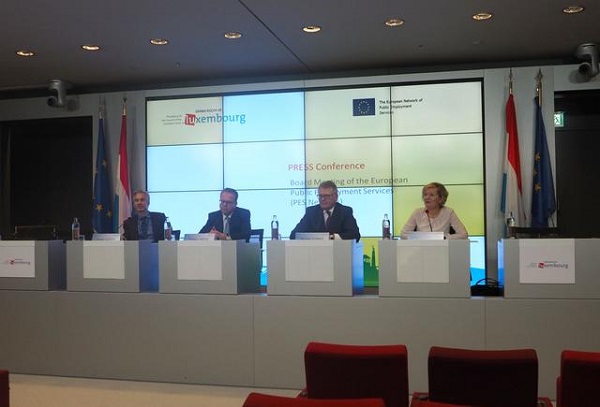
Monday 14 December 2015 marked the first day of the 4th Heads of European Public Employment Services (PES) Board meeting.
The meeting is taking place on 14 and 15 December in the Grand Duchy, under the Luxembourg Presidency of the Council of th European Union. The PES Board has discussed and exchange good practices on how to enhance labour market function, and has put the current refugee situation and long-term unemployment as top priorities on the agenda.
"The refugee crisis is a new issue we have to cope with in Europe," commented Frank-J. Weise, Chairman of the Executive Board of the Federal Employment Agency. "We want to exchange ideas and approaches from different countries on how to integrate refugees into the labour market. On the other hand, we won't forget other stakeholders which need our support, too. We still have to tackle youth unemployment and long-term unemployment in many countries in Europe. And finally, we want to support employers to find skilled workers for their companies. All these goals are important to us - we won't focus on only one aim."
Public Employment Services are the key actors in helping Europe's unemployed citizens back to work," added Stefan Olsson, Director in DG Employment, Social Affairs and Inclusion of the European Commission. "They will be at the forefront in implementing the recently adopted Council Recommendation on long-term unemployment. This recommendation aims to address a problem of grave concern, concerning more than 11 million long-term unemployed in the EU, and the PES role is critical. Furthermore, the PES will be vital in finding solutions to the refugee situation we face today, and the European Network of Public Employment Services can play a crucial role in facilitating this."
To conclude the proceedings, Luxembourg Minister for Labour, Employment and the Social and Solidarity Economy, Nicolas Schmit, presented the results of the Luxembourg Presidency in terms of employment and social policy. A highlight was the agreement on the regulation on a European network of Employment Services (EURES) and the deal on the Commission's proposal to establish a platform against undeclared work.
Minister Schmit made reference to Luxembourg's initiative to invite several Maghreb Employment Ministers for an exchange of views and insight into improving vocational training and to help people find a job.
"Europe must also look a bit further - we have lots of problems here, but the problems of our neighbours are also our problems," the Minister concluded.
Photo by ADEM (L-R: Stefan Olsson, European Commission; Frank-J. Weise, Bundesagentur für Arbeit; Nicolas Schmit, Minister of Labour, Employment and the Social and Solidarity Economy; Isabelle Schlesser, ADEM)