During the Health section of the Employment, Social Policy, Health and Consumer Affairs (EPSCO) meeting held in Brussels on Monday 7 December 2015, the Council adopted conclusions on alcohol-related risks, personalised medicine, dementia support and medical devices.
EU Strategy to Tackle Alcohol-Related Issues
The Council meeting was chaired by Luxembourg Minister of Health, Lydia Mutsch, who commented on the need for an EU strategy to reduce alcohol-related harmful effects, stating "It is our duty to act! The Luxembourg Presidency fully endorses the calls from Ministers of Health, but also the clear invitation from the European Parliament in favour of a new strategy of the Union on alcohol."
Alcohol abuse was cited as an important risk factor for health and society as a whole which causes 3.3 million deaths annually worldwide and generates direct and indirect social costs which have been estimated at several hundred billions a year. With this in mind, the Council invited the Commission to adopt a new strategy aimed at reducing the harmful effects of alcohol by the end of 2016. This strategy would address the health, social and economic consequences of alcohol abuse and would focus on cross-border initiatives employing the fields of marketing, advertising or internet sales.
Personalised Medicine for Patients
Personalised medicine has previously been highlighted as a priority of the Luxembourg Presidency in prevention programmes against obesity, cancer and other rare and complex chronic diseases. Whilst this could hold the potential to improve the health of many patients, integrating personalised medicine into daily care is difficult due to the obstacles inherent in access to these targeted treatments.
"The challenge raised is establishing a framework to provide the right treatment to the right patient at the right time," explained Minister Mutsch. "For the first time a Presidency managed to advance discussions on possible solutions to propose, and lay the foundations for a European strategy in personalised medicine."
The Council invited Member States to support a patient's access to personalised medicine through the exchange of good practices, the implementation of information and awareness strategies to improve knowledge of existing treatment options and the promotion of adequate training for health professionals. In return, the Commission was asked to back Member States in the interoperability of electronic health records, data collection and sharing, as well as continued work on fast and secure access to drugs.
Improving Care Policies and Practices in Dementia Support
With 47.5 million people affected by dementia around the world, including 6.4 million in Europe, the mental health issue was described by the Luxembourg Health Minister as "a real socio-economic challenge that is putting a strain not only on the patient and their family, but also the sustainability of our health system." She continued: "This is why we discussed dementia as a societal phenomenon, which requires multi-sectoral responses."
The conclusions in this regard called on Member States to underscore dementia as a priority, with particular emphasis on the prevention of risk factors, early diagnosis and appropriate post-diagnostic care. Destigmatisation, the exchange of best practices and enhanced investment in research were all cited as target areas, as were the role and training of formal and informal carers and the active role of patients and the support of those around them.
Lessons on Public Health Drawn from the Ebola Epidemic in West Africa - Health Security in the European Union
The last two years marked the largest ever recorded outbreak of Ebola, with more than 28,000 reported and confirmed cases. The diseases took more than 11,000 lives, including those of 500 medical professionals, and revealed a need to further improve preparedness plans and the response of Member States to maintain and strengthen capabilities in the EU in the event of possible future events.
Minister Mutsch was of the opinion that "In the future, it is important to exchange best practices in the field of prevention and treatment of the Ebola viral disease, define the medical evacuation capacity of the EU and agree on the provision and mode of operation of mobile teams on site".
Medical Devices and the Commission's Report on Trans Fatty Acids
An additional topic of discussion was the revision of the acquis on medical devices, in which the Luxembourg Presidency has invested a significant proportion of its efforts. Negotiations were opened on all political issues on which the institutions will deepen discussions to reach an agreement, with the Minister claiming that the ground had been prepared for reaching an agreement in the next Presidency.
The meeting was closed with a presentation from the Commission regarding the presence of fatty acids in food, a report that had originally been expected for December 2014. The report found that establishing limit values remained the most effective measure in reconciling the various requirements of public health, consumer protection and internal market regulations. The Commission however stated that it was necessary "to consider further how such a limit could be technically implemented."
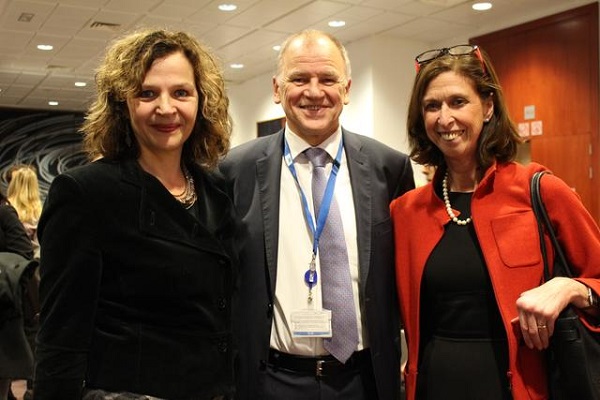
Photo by MSAN (L-R: Edith Schippers, Minister of Health of the Netherlands; Vytenis Andriukaitis, European Commissioner of Health and Food Safety; Lydia Mutsch, Minister of Health of Luxembourg)