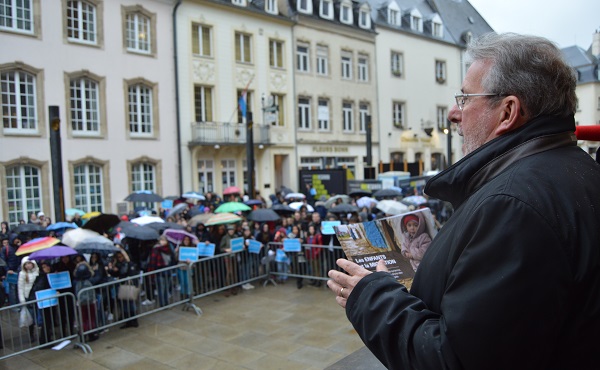
On Friday 20 November 2015, hundreds of Luxembourg school students braved the rain, joining forces and hands to create a human chain in solidarity with young refugees as part of Universal Children's Day.
The event was organised by UNICEF-Luxembourg and involved hundreds of students from several schools around the Grand Duchy forming a long human link from Cercle Cité in Place d'Armes and the Grand Ducal Palace to show their solidarity with refugee children who have been forced to flee their homes, have been separated from their families and have undergone traumatic journeys to escape the terror ripping apart their home countries.
Students raised signs declaring 'Children First' and 'Refugee Children=CHILDREN. Every child has the same rights' high in the air, with many holding hands or linking arms to show their support.
The UNHCR has reported that at the end of 2014, 60 million people, half of which were children, were uprooted worldwide due to conflict, persecution or human rights violations. In 2014, 42,000 people became refugees, internally displaced people or asylum seekers every day, due in large part to the conflict in Syria which has plagued the country for nearly five years.
Almost 8 million people have been displaced inside the country, with more than 4 million fleeing to the neighbouring countries of Turkey, Libya, Jordan and Iraq. This represents the largest ever population displacement recorded in the world, and with no sign of reconciliation on the way 12.2 million people, of which 5.6 million are children, are still in urgent need of humanitarian aid.
Children represent a quarter of the refugees attempting to escape horrors at home in search of safety in Europe, who must endure perilous journeys, exhaustion, hunger and cold to reach their goal. A number of these children are also unaccompanied, as in the case of Hanin, a young Syrian girl who was only 13 when she left the country with her family to escape the conflict. After travelling to Istanbul, the family moved on to Bulgaria, where Hanin became separated from them and was later smuggled into Austria from Hungary in the boot of a car.
In order to help these refugee and migrant children, UNICEF has reinforced its support in transit countries such as the former Yugoslav Republic of Macedonia, Serbia and Croatia. Measures include providing 'amis d'enfants' spaces, where children can rest, play and receive food and warm clothing; psycho-social support for traumatised travellers; drinking water and food; medical care; clothing and nappies for infants; and information material, offered in Arabic.
In European countries of destination, UNICEF also offers assistance to governments in order to ensure the implementation of effective procedures for migrant and refugee children which are in the children's best interests and in respect of international norms. UNICEF has also provided support to governments and local partners in Greece, Italy, Hungary, Austria and Germany and is in the process of identifying possible areas of technical support.
After forming a human chain, participating students in the City embarked on a solidarity march to the Chamber of Deputies, where they were greeted by President of the Parliament Mars Di Bartolomeo for a report of the event.
"Children are children," declared Mars Di Bartolomeo, who went on to say that every young person was deserving of dignity and human rights, thanking the young students for the support shown to their Syrian peers and other refugee children facing immense tragedy.
To find out more on the work done by the UNICEF organisation, visit www.unicef.lu.
Photos by Sarah Graham