Fairtrade Lëtzebuerg today presented the evolution of Fairtrade in 2014-15, including various projects that have had positive impacts for producers in the South.
Fairtrade is a social movement that has been in operation for the last two decades to improve the living and working conditions of disadvantaged producers and their familes in the South, ensuring a better future for them and the communities they live in. This movement currently incorporates over 1.5 million producers and 1,210 producer organisations from 74 different countries. Their representatives hold 50% ov vote participation in decisions within the Fairtrade system.
Fairtrade Lëtzebuerg reported that the Fairtrade market in Luxembourg is ever-changing and dynamic, but is not without its fair share of challenges. In 2014, the sale of Fairtrade products in Luxembourg generated a turnover of €10.7 million, indicating €19.48 spent on these products for every resident of the country and ranking it 6th in world for resident Fairtrade consumption.
Over 1400 products are available to buy equitably in over 195 outlets across Luxembourg, with bananas representing the product with the largest market share at 26.40%, closely followed by roses (19.84%) and coffee (6.59%). However, despite the popularity of flagship products such as cocoa and coffee and the more recent success in gold and cotton, shares in these goods remain low and Fairtrade Lëtzebuerg stated that the support of committed partners would be fundamental in advancing Luxembourg's Fairtrade economy.
One such example given by the association was the decision of the Banque Centrale du Luxembourg (BCL) to release the very first Fairtrade gold collection to the world. 15 kilos of gold from the Sotrami and Aurelsa mining organisations of Peru were used to celebrate the 175th anniversary of Luxembourgish independence, representing 58% of all Fairtrade gold sold in 2014. Fairtrade Lëtzebuerg commented that this project demonstrated the positive consequences that the purchasing of Fairtrade material in the Norther can have on its producers in the South, as it generated not only recognition for the work of the Peruvian miners but also a Fairtrade premium of €34,000, which was then put towards realising social projects in the community.
Recognition was also given to awareness campaigns initiated in Luxembourg, such as the 'Fair Fashion' campaign which was launched by the Fir de Fairen Handel asbl association in the first half of 2015. Together with partners Fairtrade Lëtzebuerg and Caritsa Luxembourg, a solidarity tribute was organised for the victims of the Rana Plaza collapse, wherein 1,129 workers at the garment factory in Bangladesh were killed and a further 2,515 injured after a structural failure caused the building to collapse in April 2013. The campaign also involved a round table and Fair Fashion event selling ethically-friendly clothing and home textiles.
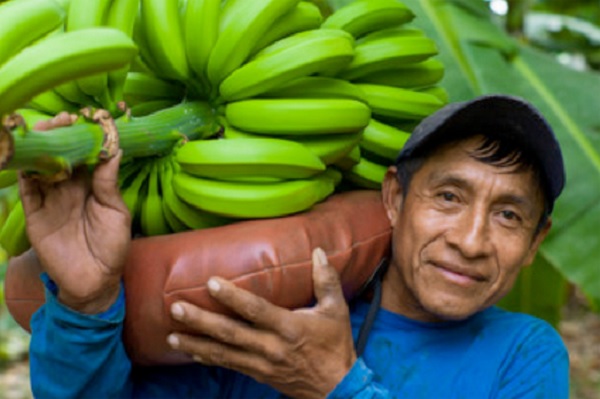
The Pall Center shopping village was also commended for its decision to exclusively offer Fairtrade bananas from organic agriculture, which came into affect in April. Bananas on the Luxembourg market are largely derived from the Peruvian cooperative APPBOSA, which allows producers to receive a minimum price of $12 dollars for every 18.14 kilo box of organic Fairtrade bananas from Peru. Producer organisations also receive an additional Fairtrade development premium of $1 per box.
The money obtained in addition to the minimum price plays an important role for the development of said organisations, as well as the entire region, as an autonomous and democratic allows producers to then decide which projects to implement through the premium. This has and may contribute to new systems to improve quality or productivity; the development of medical treatment and higher training; the set-up of cable installations for the transport of bananas; and the support and assistance for local children in the community through the purchase of school supplies. Producers in the South received, in addition to guaranteed minimum prices, a total sum of €200,000 Fairtrade premiums in 2014.
Fairtrade standards are based on the three pillars of sustainable developments, these being social, economic and environmental. A UN Summit on Sustainable Development to be held in September of this year will see the adoption of seventeen Sustainable Development Goals (SDG), extended from Millenium Development Goals. A number of these SDG proposals will focus on producers and workers in the international supply chain, with Goal 8 calling for sustainable economic growth and decent work for all and Goal 12 establishing modes for sustainable production and consumption.
Fairtrade Lëtzebuerg claimed that Fairtrade holds the potential to meet these objectives, explaining that for poverty to be reduced through trade, fair prices must be paid and for sustainability and social justice to be achieved, long-term contracts covering the costs of market production must be regulated.
The association went on to pledge that it will work towards this end, helping to achieve the SDG by giving a voice at the highest level to Fairtrade producers and workers. It stated that both local and international political leaders needed to collaborate to ensure that the SDG replacing the Millenium Development Goals be enforced and their objectives implemented.
Top photo by Santiago Engelhardt. Bottom photo by Fairtrade Lëtzebuerg