At an informal meeting of Ministers of Agriculture held yesterday at the European Convention Center Luxembourg, ministers continued discussions of the €500 million package proposed by the European Commission at the extraordinary Agriculture Council of 7 September 2015 to assist Europe's struggling agriculture industry.
At the meeting on 7 September 2015, the national allocation of the package had not been fully determined by the European Commission, with only a promise made that the aid would be distributed in a "fair, focused and effective" way with special attention paid to the Member States found to have been the most badly affected by the agricultural crisis.
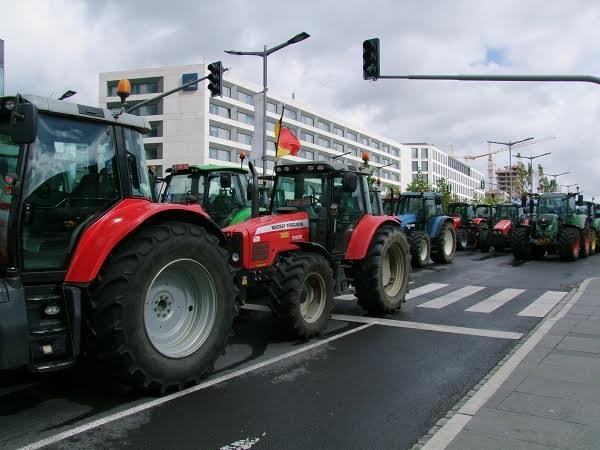
Yesterday, as protesting farmers and agriculturalists drove their tractors through Kirchberg in a demonstration of discontent, the ministers "stressed their concern for the situation of agriculture and in particular the dairy and pigmeat sectors" and "confirmed their willingness to enlist all available means for these critical sectors of the European economy," according to Luxmbourg Minister for Agriculture and President of the AGRI Council, Fernand Etgen.
The Minister continued by stating that together the ministers "had welcomed the package of measures announced by the Commission as a first response to the situation" and had "noted the clarifications made by Commissioner Hogan on the implementation of the package", who explained that the Commission would consider the difficulties of Member States particularly affected by falling pork and dairy prices and that it would be allowing Member States 'maximum flexibility' in how they chose to allocate aid to the various sectors affected.
€420 million of the overall €500 million package has been set to be paid directly to EU Member States in a distribution process that will take into account milk production levels and cyclical impacts such as the Russian embargo or drought.
This part of the package is expected to be paid in mid-October, which will see Germany and France receive the majority shares of 69.2 and 62.9 million respectively, followed by the UK (36.1 million), Poland (28.9 million), the Netherlands (29.9 million), Spain (25.5 million) and Italy (25 million).
Commissioner Phil Hogan also reported that in terms of potential advances of Common Agricultural Policy (CAP) aid granted to farmers by each Member State, the Commission would ease controls to allow up to 70% advances in mid-October, stating "Farmers will be able to receive cash before the end of the year".
Private storage aid will also be contributed to bacon on the pork market and a new programme will be established for skimmed milk powder, increasing financial assistance 100% and stretching the duration of private storage.
"We also want to take promotion measures and we want to be more hostile regarding commercial openings to capture new markets and sell our European products," added Commissioner Hogan.
Around €30 million has been planned for a programme ensuring the distribution of European milk to refugees, with the Commissioner pledging that "this money will be allocated to the various charities that work with the European Commission Humanitarian Aid and Civil Protection service (ECHO) to cope with the refugee crisis".
Fernand Etgen claimed that the Ministers were aware of "the necessary flexibility of administrative control in this first year of the CAP" regarding advances on payments, stating that "certain Member States stressed the need to simplify the provisions for aid payment".
However, the Minister indicated that certain Member States had not been satisfied with various aspects of the measures that had been put forward.
"Without questioning the market orientation of the CAP, some think that such measures should be prolonged in respect of certain structural aspects of the milk and pork markets," commented the Minister.
The news was also not well received by Luxembourg's farming population, who had gathered outside the European Convention Center on Place de l'Europe in their second protest of recent weeks.
During the meeting Luxembourg was allocated €700,000 which, despite its status as a small country, would mean a mere €1,000 per farmer - what some protesters believed to be a small plaster attempting to cover a gaping hole in the agricultural industry of the Grand Duchy. In response, the farmers conveyed their dismay by throwing eggs and around a thousand litres of milk outside the Convention Centre.
Photo by Geoff Thompson