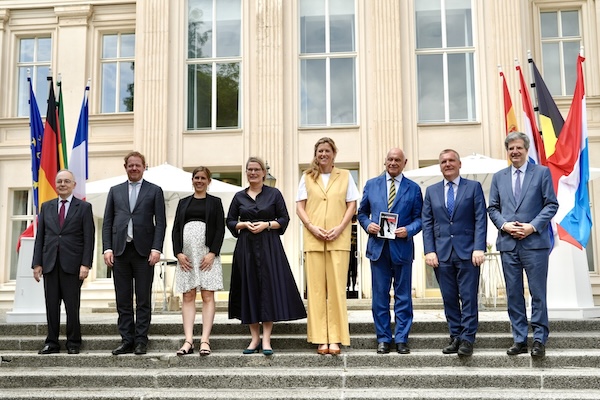
 Credit: MJUST
On Tuesday 30 June 2026, Luxembourg's Minister of Justice, Elisabeth Margue, attended a meeting of the Vendôme Group of justice ministers in Berlin, Germany, where discussions focused on combating online violence, strengthening the protection of women against all forms of violence and enhancing the resilience of judicial systems.
According to Luxembourg's Ministry of Justice, the ministers stressed the need to better address contemporary forms of digital violence, exchanged views on national initiatives and shared best practices in combating violence against women. During the meeting, Minister Margue presented Luxembourg's draft legislation aimed at strengthening the fight against cyberviolence by adapting criminal law to new forms of violence made possible by technological developments.
The proposed reform seeks to better protect victims, enable earlier intervention against violent behaviour and address new forms of violence, particularly in the digital environment. It would introduce new criminal offences, including coercive control, cyberflashing, sextortion and the non-consensual sharing of intimate images, including those generated using artificial intelligence. Sexual harassment would also be explicitly recognised in the Criminal Code and could be prosecuted even where a single act has lasting consequences for the victim.
The ministry added that the reform forms part of a broader strategy to strengthen protection for victims. Since 1 May 2026, the National Centre for Victims of Violence (CNVV) has been operating 24 hours a day, providing psychological, medical and legal support in a single location. Victims can receive assistance, have incidents documented and preserve evidence without having to file a complaint immediately.
Minister Margue said: "Violence against women is neither an isolated incident nor inevitable. Every victim must know that the State stands by their side and that they can seek help without delay or fear of taking the first legal step."
The reform also aims to address violent behaviour before it escalates into the most serious offences. Minister Margue said femicides are often preceded by the same pattern of behaviour: control, intimidation, isolation and threats. By recognising coercive control as a criminal offence, she said the justice system would be able to intervene earlier and help prevent irreversible harm.
The proposed legislation also seeks to address the growing impact of online violence, particularly on the education and behaviour of young people, while preserving the principle of technological neutrality in criminal law.
Minister Margue stated: "Perpetrators must not be able to hide behind a screen. Digital violence is violence in its own right and deserves a strong criminal law response. Our legislation must evolve at the same pace as technology."
She also called for coordinated action at European level to increase the accountability of online platforms and strengthen the protection of minors in the digital environment.
"The internet cannot be a lawless space. Luxembourg supports an ambitious European approach to better protect women, children and all victims of online violence," the minister added.
According to the ministry, the reforms reflect the Luxembourg Government's commitment to building a justice system that is more protective, more responsive and better adapted to today's challenges. It stressed that protecting victims, preventing violence and combating impunity remain absolute priorities.
The Vendôme Group is an informal platform bringing together the justice ministers of the Benelux countries, France, Germany, Italy and Spain. It held its first meeting in Paris on 7 November 2018.