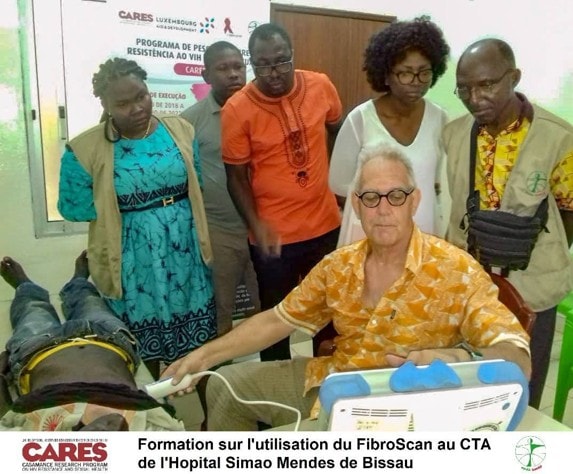
 Training on the use of FibroScan at the CTA of Simão Mendes Hospital in Bissau;
Credit: Enda Santé
Training on the use of FibroScan at the CTA of Simão Mendes Hospital in Bissau;
Credit: Enda Santé
On Tuesday 28 July 2026, on the occasion of World Hepatitis Day, Enda Santé and Luxembourg-based association SAN/ACCESS reported on the progress of the Luxembourg-backed CARES project, which has screened more than 27,600 people for hepatitis B in Senegal's Ziguinchor region since 2018.
Implemented by Enda Santé and funded by Luxembourg's Ministry of Foreign and European Affairs, Defence, Development Cooperation and Foreign Trade, the project combines research, healthcare capacity building and medical care to improve the detection and treatment of hepatitis B.
According to the organisations, 3,313 people diagnosed with the virus are receiving medical follow-up, while 273 have started antiviral treatment.
The second phase of the programme, CARES II, has been running since September 2023. During this period, 7,362 people, including 2,355 pregnant women, have been screened, with 569 people testing positive for the virus, representing 7.84% of those screened.
The project currently provides medical follow-up for 1,922 people living with hepatitis B, including 189 receiving care as part of efforts to prevent mother-to-child transmission. Of these patients, 181 are receiving antiviral treatment.
CARES II has also enabled 1,217 FibroScan ultrasound test, a non-invasive technique used to assess liver health, as well as 658 abdominal ultrasounds, helping healthcare professionals monitor disease progression and tailor treatment to patients' needs.
Henri Goedertz, President of SAN/ACCESS, emphasised: "Screening only achieves its full impact when it leads to a complete care pathway. Every person diagnosed must be able to access the necessary examinations, receive regular follow-up and be provided with treatment when indicated. This connection between communities, healthcare structures and research lies at the heart of the partnership established with Enda Santé.”
Beyond patient care, the CARES programme supports research, healthcare professional training and the development of diagnostic capacity for HIV, hepatitis B and human papillomavirus (HPV) in Casamance and Guinea-Bissau.
CARES II also includes research into the potential elimination of hepatitis B in Senegal's Oussouye health district by combining prevention, screening, access to healthcare and long-term medical follow-up. The organisations said the findings could help shape hepatitis B elimination strategies in Senegal and elsewhere in West Africa.
The project aims to bring together healthcare, academic and civil society partners from Senegal, Guinea-Bissau and Luxembourg, combining scientific expertise with community-based approaches to strengthen access to diagnosis, treatment and long-term care.