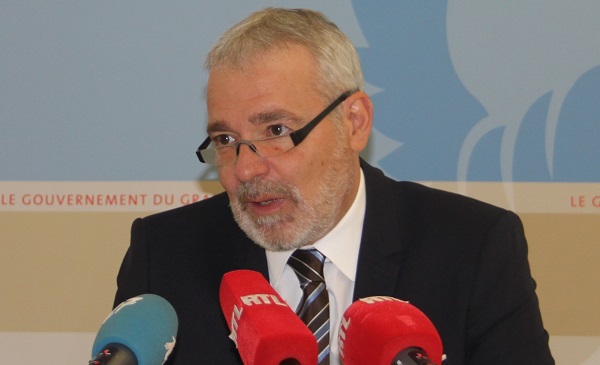
 Employment Minister Dan Kersch;
Credit: MTEESS
Employment Minister Dan Kersch;
Credit: MTEESS
On Thursday afternoon, Luxembourg’s Deputy Prime Minister and Minister of Labour, Employment and the Social and Solidarity Economy, Dan Kersch, and Minister of Social Security, Romain Schneider, participated in a videoconference with their European counterparts on the consequences of coronavirus.
During this conference, European Union (EU) ministers discussed the measures which have already been taken by the Member States and actions at the European level.
Following this videoconference, Ministers Dan Kersch and Romain Schneider held a virtual press conference on the recent decisions taken by the Luxembourg government at the national level as well as the results of the videoconference discussions.
Employment Minister Dan Kersch began by confirming that he was still engaged in discussions with France, Belgium and Germany regarding the pandemic and the border situation, adding that “we are strong, but we are stronger […] together”.
For his part, Social Security Minister Romain Schneider stressed the need for solidarity with and among individuals and companies. On the topic of paid family leave, Minister Schneider recalled that this measure was available for working parents with children under 13 or children with disabilities. He asked employers and employees to be “reasonable” and take advantage of this possibility, adding that there had already been 1,500 requests to the CNS so far. Minister Schneider also confirmed that family leave could be prolonged depending on the duration of school and childcare closures.
In addition, Romain Schneider reiterated that the authorities have implemented (and will continue to seek) various measures to support employers, for instance ensuring they can pay their employees’ salaries.
Concerning the health sector, the Social Security Minister recalled that teleconsultations are a new, safer possibility for doctors, dentists and other healthcare professionals to support their patients at this time. He added that it remained the responsibility of the healthcare professional to determine patient’s state of health on a case-by-case basis. Refunds will function as normal for the time being. He added that the Luxembourgish authorities were in close contact with other EU Member States to establish a common strategy at the European level in this area.
After thanking those working in the health sector for their continued efforts, Romain Schneider, who is also the current Minister of Agriculture, Viticulture and Rural Development, turned his attention to the agricultural sector. He stressed that continued food production, like continued efforts in the health sector, was essential. He thus emphasised the need to support the entire food production chain in order to guarantee food security, adding that it would be important for Luxembourg to continue to produce its own high-quality produce both now and in the future. He concluded by thanking all those working in this sector.
Dan Kersch then discussed the labour market situation. He began by pointing out that the number one priority and reason for the government’s recent measures was to protect people. He added that the Luxembourg labour market was closely linked with the factor of time and thus the main task at hand was to ensure that people get paid at end of month. Minister Kersch also stated that the government had already received 3,200 requests for partial unemployment from companies this month.
Moreover, the Employment Minister confirmed that companies that had been forced to shut down in light of government restrictions are eligible for partial unemployment benefits. He recalled that companies will be able to apply retrospectively (16 March) for such compensation via a new procedure to be presented in the coming days. He added that the 2019 budget for partial unemployment was set at €11 million, although this year is expected to be more as a result of the current crisis.
Minister Kersch went on to recognise that a lot of the measures being taken at present will be costly for everyone involved. He added that the government is trying to ensure that the necessary checks are being carried out but that this is not always possible at present. Consequently, the authorities will monitor these expenses at a later date.
Dan Kersch concluded by reiterating that the current situation requires understanding from all and continued dialogue with one another. If this can be achieved, then “together we’ll manage”.