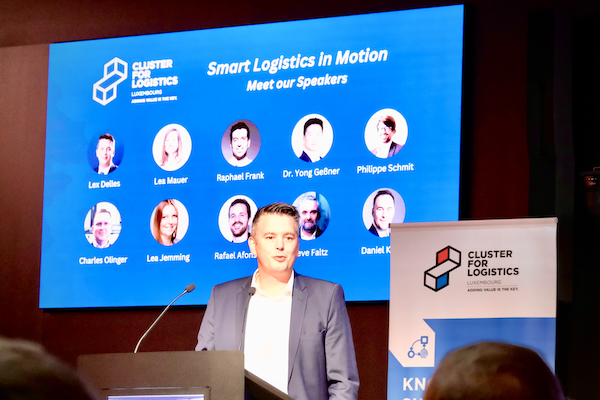
 Lex Delles, Luxembourg Minister for the Economy, SMEs, Energy and Tourism;
Credit: Steven Miller, Chronicle.lu
Lex Delles, Luxembourg Minister for the Economy, SMEs, Energy and Tourism;
Credit: Steven Miller, Chronicle.lu
On Wednesday 7 October 2026, Luxembourg’s Cluster for Logistics Asbl (C4L) hosted its “Smart Logistics in Motion” conference at the Luxembourg Chamber of Commerce in Luxembourg-Kirchberg.
The conference brought together industry leaders, researchers, technology providers and public authorities to explore the next generation of freight mobility and featured discussions which focused on autonomous vehicles, artificial intelligence-powered operations, smart infrastructure and sustainable urban logistics, as well as the use of electrification and hydrogen in the transition towards zero-emission freight transport.
The event welcomed around 100 attendees and was opened with a welcome address from C4L Director Daniel Kohl, who welcomed those in attendance before detailing the conference’s programme. He noted the importance of the strong link between Luxembourg’s industries, research hubs and public authorities in making the country a successful logistics and innovation hub .
There then followed a keynote address from Luxembourg’s Minister for the Economy, SMEs, Energy and Tourism, Lex Delles, who talked of his recent working visit to China, where he was accompanied by representatives of Luxembourg’s Chamber of Commerce and around 100 Luxembourg companies.
The minister remarked that Luxembourg and its industries must find partnerships to be prepared for the future and said: “By looking for partnerships, by looking for know-how with other companies, these are crucial elements for the development of the logistics sector of tomorrow,” and highlighted the government’s development of the bill for autonomous driving/vehicles in the Grand Duchy as an example of how collaboration can help move the country forward.
“We are the country of the short ways. We can decide rapidly. We can bring people together from different parts of the Luxembourgish economy and also from the organisations we need just to deploy autonomous driving here in Luxembourg.”
Minister Delles noted that Luxembourg wants to be one of the first countries to authorise autonomous driving but stressed the importance of collaboration in all of the country’s logistical and technical areas is needed to make such a move a success, “It goes hand in hand with other strategies that have already been mentioned, whether it is the questions of data, whether it is the questions of artificial intelligence, whether it is also the questions of networks.”
He added: “The collaboration with the different partners… shows that the sector of logistics, the sector of autonomous driving, is in full development here in Luxembourg and we can be proud of it. We ask ourselves how to move faster, how to be able to agree with the questions that we can ask ourselves tomorrow, and these are useful for the logistics sector of tomorrow and especially the day after tomorrow.
On the future of Luxembourg’s logistics landscape, Minister Delles noted the importance of developing and attracting the right talent to the industry: “It is a sector that deserves to be on the agenda, not only of politics but of all companies. When we talk about the talents that we need today, that we need tomorrow, we need young people who will have a diploma today, which shows precisely that it is a sector with a future, where there are the talents that we manage to train here in Luxembourg and that we manage to have on a larger scale. This shows more than ever that it is a sector that has a future here in Luxembourg and elsewhere.”
Following his speech Minister Delles presented the 2026 awards to the top-performing students of the Logistics Technician Diploma programme.
There then followed three presentations on Autonomous Driving featuring contributions from Lea Mauer, Project Manager - Luxembourg Ministry of the Economy, Raphaël Frank, Professor & Chief Scientist at SnT, University of Luxembourg, and Dr Yong Geßner, VP - Head of Europe of Neolix.
Lea Mauer talked of the government’s automated driving strategy and its ambition to enable the deployment across Luxembourg and the full territory by 2028, positioning the country as a European hub for automated mobility.
“We try to connect the automated driving strategy with our broader economic strategy and also mobility objectives, and we see also the strategy as a strategy for economic diversification,” said Lea Mauer.
“We see opportunities to develop on the one hand new services, new value chains, but also to create skilled jobs for the transition. We also want these technologies, not only for the technological advancement, but also to contribute to a safer and also a more efficient mobility.”
She noted the importance of governance and regulation, and the need for “a clear legal administrative framework” which companies can use to validate, test and deploy their automated vehicles, and highlighted the strength of Luxembourg’s innovation ecosystem: “We need to develop the skills and the talent that is needed for the transition. We have the ecosystem and infrastructure pillar, and we try to develop physical and also digital environments for this transition… We have different support mechanisms and services. We have LuxElevation that supports different companies on their platform projects and implementation, but we also have state aid schemes provided by the Ministry of Economy that will also help you on the way to the implementation.”
In his presentation, Raphaël Frank provided an overview of the development of autonomous systems at the University of Luxembourg, noting the interdisciplinary nature of the field, which incorporates computer science, engineering and artificial intelligence (AI). He detailed the work done on developing an electric vehicle modified in order to drive itself and the open source software used to control it.
“Our ambition is that we develop a certain expertise here in Luxembourg so that we can train new engineers and researchers on that topic, and so that they stay up to date, and having this vehicle is a perfect playground also for master's students, for example, their master's thesis. And we are so fortunate that in Luxembourg we have an authorisation to do tests on public roads,” said Raphaël Frank.
Dr Yong Geßner gave a presentation in which he detailed the variety of driverless vehicles Neolix has developed and implemented in various regions of China, and how the company approached the challenge of developing autonomous vehicles, not just as a delivery service, but as a point-to-point task which includes the infrastructure needed to utilise autonomous services successfully, such as connectivity, charging and the importance of the role insurance companies play in supporting autonomous systems and making them a reality.
He also announced that Luxembourg will be the headquarters for Neolix’s European operations, emphasising the Grand Duchy’s “fantastic ecosystem” and its “very active, innovative ministry.”
The event continued with presentations on “Energy Value and Independence” by Philippe Schmit, Director of Operations atSGI Ingénierie; “Secure and sustainable truck parks” by Charles Olinger, Senior Logistics Research Manager at Schroeder & Associates; and “Reimagining urban freight for climate-neutral cities” by Steve Faltz, Industrial Engineer at City of Differdange.
Following the presentations, attendees were invited to a networking drink with refreshments supplied by the hosts.