 Credit: STATEC
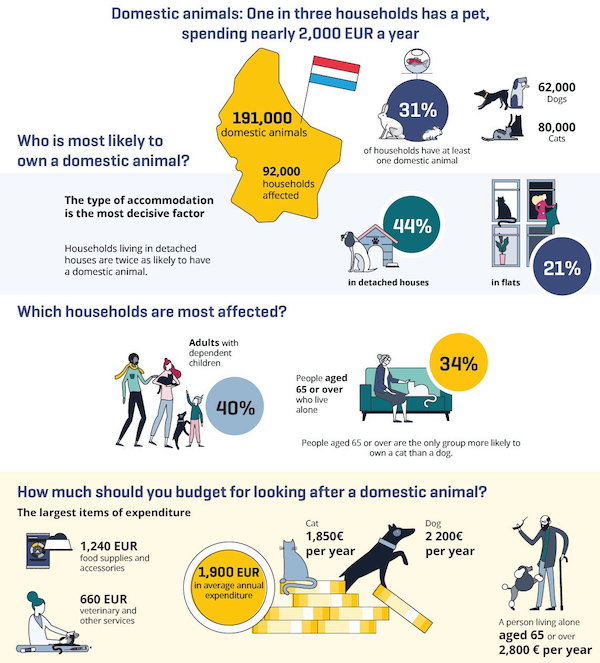
In a report published on Tuesday 27 October 2026, Luxembourg's national statistics institute, STATEC, revealed that one in three Luxembourg households owns a pet, at a cost of approximately €2,000 per year.
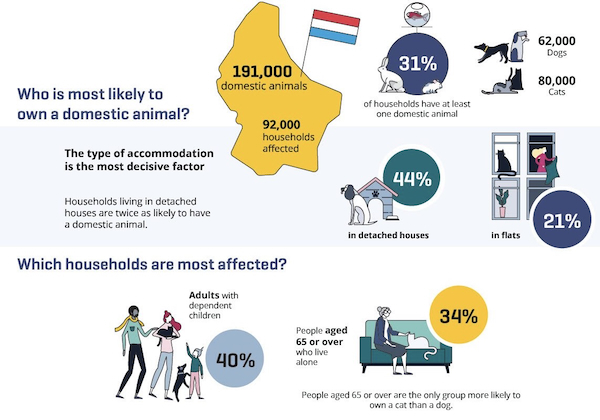
According to STATEC, pet ownership is more common amongst households living in detached houses (43% own a pet, compared with 21% of households living in flats), amongst households in the middle of the income distribution (37%), as well as amongst households with dependent children (40%) and single people aged 65 or over (34%). Expenditure on pets is expected to average 1,900 €per household in 2025. However, this expenditure varies according to household profile: it is relatively higher for dog owners and single people aged 65 and over.
In 2025, nearly 92,000 households, or approximately one in three, had at least one pet in Luxembourg. The country had a total of 191,000 domestic animals, including nearly 80,000 cats and 62,000 dogs. Pet ownership was more common among households living in detached houses (43% owned a pet, compared with 21% of households living in flats), households in the middle of the income distribution (37%), households with dependent children (40%) and single people aged 65 or over (34%). In 2025, average pet-related expenditure amounted to €1,900 per household. However, spending varied according to household characteristics and was relatively higher among dog owners and single people aged 65 and over.
In 2025, 92,000 households had pets, representing nearly one in three households, while 200,000 households did not own any. More specifically, 53,000 households owned one animal, 22,000 owned two and 17,000 had three or more.
Certain household characteristics, such as housing type, income and household composition, are associated with the likelihood of owning a pet.
Households living in detached houses are twice as likely to own a pet
STATEC reported that housing type is strongly associated with the presence of domestic animals in the household. More than four in ten households (43%) living in detached houses owned at least one domestic animal, compared with 21% of those living in flats.
The difference was particularly pronounced for dogs: 27% of households living in detached houses owned a dog, compared with just 9% of households living in flats. The larger living space available to households in detached houses, potentially including an outdoor area, makes keeping a dog more convenient.
The difference was less pronounced for cats, which were present in 20% of households living in detached houses and 12% of those living in flats. Households in detached houses therefore more often choose dogs, while those living in flats more frequently choose cats.
Pet ownership is only slightly influenced by income
Income appears to have relatively little association with pet ownership. Unlike the differences observed according to housing type, variations between income quintiles remain relatively limited. The proportion of households owning at least one animal ranges from 27% to 37% depending on the income quintile, peaking in the third quintile before falling to 31% among the wealthiest 20% of households.
When looking only at dog and cat ownership, income appears to have even less influence. Differences between quintiles are particularly small for cats, although slightly higher cat ownership is observed among lower-income households. Differences are somewhat more pronounced for dogs, whose presence peaks in the fourth quintile.
Single people aged 65 or over and households with children are more likely to own a pet
The presence of a domestic animal varies considerably according to household composition. Nearly 40% of households with children owned at least one animal, compared with 27% of couples without children. Among people living alone, pet ownership was significantly more common among those aged 65 or over: 34% owned at least one animal, compared with just 13% of people aged 35 or under.
The type of animal owned also varies according to household composition. Households with children were more likely to own a dog (23%), while single people aged 65 or over were more likely to own cats (24%). By contrast, only 13% of single people aged 35 or under owned a domestic animal: 7% owned a dog and 4% a cat.
Older people living alone were also more likely to own at least two different types of pet: 7% owned at least one cat and one dog. The same was true of 5% of couples with children.
Households spent nearly €2,000 a year on their pets
In 2025, households owning at least one animal spent an average of more than €660 on veterinary fees and other animal-related services, while expenditure on food and accessories reached €1,240. In total, these households spent nearly €1,900 on their pets in 2025.
Households with dogs spend more
Expenditure varies according to the type of animal owned. In 2025, veterinary fees and other services averaged €827 among households with a dog, more than €200 above the figure for households with a cat. Spending on food and accessories approached €1,400, around €150 more. Overall, annual expenditure exceeded €2,200 for households with a dog, compared with approximately €1,850 for those with a cat.
Higher expenditure among households living in detached houses
Housing type is also associated with expenditure levels. In 2025, households living in detached houses spent an average of approximately €2,100 on their pets, compared with nearly €1,700 among those living in flats. This difference was mainly attributable to spending on food and accessories.
However, this finding should be considered alongside the higher prevalence of dog ownership in detached houses. It therefore does not establish that housing type alone explains the difference in expenditure.
Expenditure does not increase steadily with income
Spending varies according to income, but there is no consistent upward trend from one quintile to the next. In 2025, the highest expenditure was observed in the fourth quintile, where it reached nearly €2,500. Veterinary fees and other services do not, however, show a clear income gradient, meaning that they do not vary systematically with income.
Expenditure varies considerably according to household composition
In 2025, single people aged 65 or overspent almost €3,000 on their pets, the highest amount among the categories studied. By contrast, households with dependent children spent approximately €1,550, despite being among those most likely to own an animal.
STATEC noted that pet ownership does not necessarily correspond to higher expenditure. Spending appears to be more closely associated with the type of animal owned and household composition than with income alone.