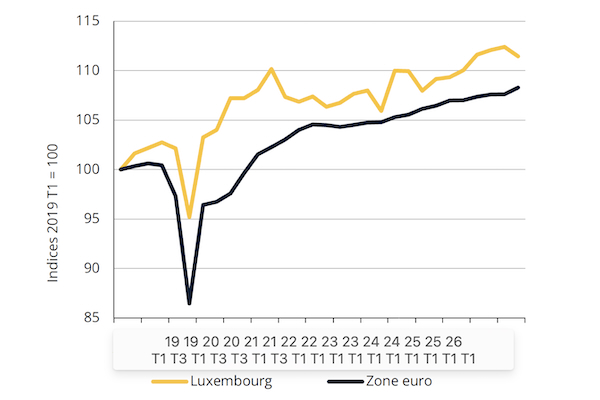
 GDP in volume, Luxembourg vs. euro zone;
Credit: STATEC
On Tuesday 28 October 2026, Luxembourg’s national statistics institute, STATEC, published its latest Flash Conjuncture report showing that the Grand Duchy’s GDP fell in the 2nd quarter of 2026 compared with the previous quarter.
GDP drops
According to the report, GDP by volume fell by 0.9% over a quarter in the 2nd quarter of 2026. STATEC said this decline is essentially linked to lower investment expenditure (gross fixed capital formation), the deterioration in the balance of trade in goods and services (in sharp increase over the previous two quarters) and, to a lesser extent, to the decrease in household consumption.
Despite this marked decline in the 2nd quarter of 2026, STATEC noted that the GDP evolution profile (such as that of value added) has been significantly revised upwards for the previous three quarters. The growth acquis for 2026, i.e. the annual increase obtained assuming that GDP stabilises at its level of the 2nd quarter over the remainder of the year, thus amounts to 0.8%, a result comparable to that which prevailed at the end of the previous publication of the quarterly accounts. Based on these elements, the growth of 1.2% expected by the STATEC for the year 2026 as a whole remains achievable.
Iran conflict impacts oil prices
STATEC detailed that after a clear deterioration in Q2, following the beginning of the conflict in Iran, the Q3 economic surveys generally showed an improvement in the morale of businesses and households, whether throughout the euro area or in Luxembourg.
For the last quarter of the year, the prospects are potentially much less encouraging, especially because of the geopolitical context in the Middle East. The price of oil continues its rise, which began in July (it crosses the $115 mark again at the end of October), relaunching inflationary pressures and tightening monetary policies. These developments are expected to affect household demand and business investment, already clearly tested by the consequences of the 2022-2023 energy crisis. In addition, in particular in response to the rise in energy prices (and its rapid impact on purchasing power) as well as difficulties in accessing housing, social movements are spreading to several European countries (France, Italy, Portugal, Greece, Belgium and Spain).
Rekindled inflation pressures
Following the sharp rise in Brent prices observed this summer, STATEC highlighted that Oxford Economics (OE), whose projections serve as the basis for STATEC forecasts, has significantly revised upwards its inflation outlook for the euro zone for the end of 2026 and for 2027.
Last July, the central scenario of OE was still based on a downflow of the Brent price to $74 per barrel in the 3rd quarter and at $72 in the 4th quarter. Now, Brent stands at about 96 USD in T3 and would even reach 112 USD in T4. In 2027, the decline would be more gradual, with the price of a barrel going from $105 in the 1st to $88 in the 4th quarter. With these new assumptions, the outlook for energy inflation in the euro zone has been strongly revised upwards: +4.7 points of % in 2026, to reach 10.2%, and +5.2 points in 2027, to reach 2.4%. Overall inflation is raised by 0.4 points in 2026 (to 3.0%) and 0.7 points in 2027 (to 2.7%).
Regarding food inflation, the anticipated rise in July, which was to bring the price increase to around 2% at the end of the year, did not materialise at this stage (+1.2% in T3). The combination of rising energy costs and extreme weather events is expected to rekindle inflationary pressures on food products in 2027 (+2.9%, compared to 2.4% in July projections).
STATEC will release its next inflation forecasts for Luxembourg on November 4, 2026.
Job positions increase in health, construction and commerce
The rate of vacant jobs, which reports open positions (reported to ADEM) to all open and occupied positions, was halved between the end of 2022 (record level of 2.7% reached during the post-Covid recovery) and the beginning of 2025. Since then, it has generally stabilized. However, this apparent stability masks contrasting developments according to the branches of activity.
Business services recorded the most marked decline. After reaching nearly 7% in the fall of 2022, the rate of vacancies gradually fell to 2% in the 3rd quarter of 2026 (-340 vacancies over a year). In industry and transport, the number of positions to be filled is also falling (-140 and -70 positions respectively over one year).
On the other hand, STATEC said the rate of vacant jobs reached record levels in health and social work (+230 positions over a year, or +1/3), even if the expansion of the workforce in this branch is among the most dynamic (+4.0% over a year in the 3rd according to preliminary data). Construction also has 200 more job offers than a year ago, echoing the improvement in hiring prospects of companies in the sector, and trade just over 100.
Marked slowdown in wages in Q2
The average wage cost (CSM) decelerated well in the Q2 in Luxembourg, increasing by only 2.1% over a year, after 3.7% in the previous quarter. This is on the one hand linked to a lower contribution of the mobile salary scale (+1.7% in T2 compared to 2.5% in T1). With the June 2026 index tranche, this contribution will increase again in Q3 (to 2.5%).
On the other hand, a sharp drop in bonuses and gratuities (about -5% over a year per employee) slowed down the evolution of the cost of wages. This decline concerns in particular the health and social action branch due to a basic effect (particularly high premiums in the 2nd quarter of 2025), which explains the sharp decline in the contribution of non-market activities to the growth of the total CSM. A significant decrease in bonuses and gratuities is also observed in the information and communication branch.
In addition, the increase in employer contributions (related to pension reform) has contributed in a stable and positive way to the growth of the CSM since the beginning of 2026. Autonomous wage increases (excluding indexation increases and the above-mentioned factors) also contribute to this, but to a more limited extent than in 2025.