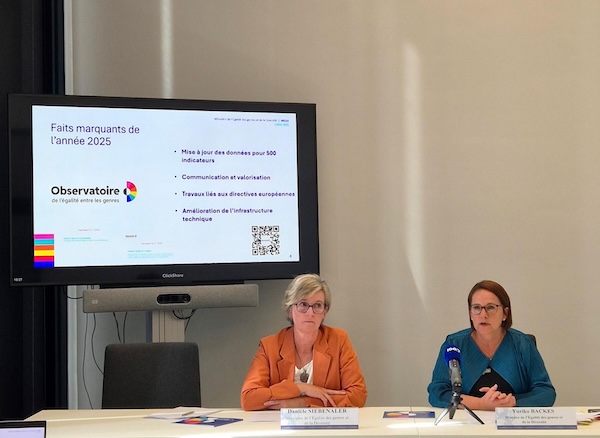
 (L-R) Danièle Siebenaler, Secretary General of the Observatory for Gender Equality; Yuriko Backes, Luxembourg's Minister for Gender Equality and Diversity;
Credit: MEGA
(L-R) Danièle Siebenaler, Secretary General of the Observatory for Gender Equality; Yuriko Backes, Luxembourg's Minister for Gender Equality and Diversity;
Credit: MEGA
On Monday 6 July 2026, Luxembourg's Minister for Gender Equality and Diversity, Yuriko Backes, presented the 2025 activity report of the Gender Equality Observatory (Observatoire de l'égalité entre les genres).
The report highlights the Observatory's activities during 2025 while presenting the latest findings on gender equality across seven areas: domestic violence, employment, decision-making, work-life balance, income, education and health.
"The Observatory's data show that progress is possible, but also that inequalities persist. They remind us why it is essential to continue pursuing public policies based on reliable data in order to build a more equal society for everyone," said Minister Backes.
The ministry noted that, following the introduction of a legal basis in 2024, the Observatory has become a key instrument for supporting evidence-based public policies through reliable and up-to-date data. During 2025, more than 500 indicators covering the seven thematic areas were updated and expanded, allowing the Observatory to continue monitoring progress and identifying remaining challenges.
The report pointed to several positive developments, including a narrowing gap in employment rates between women and men, signalling a gradual convergence in labour market participation, as well as the continued strong representation of women in higher education.
However, the ministry stressed that significant structural inequalities remain. Women continue to be overrepresented in part-time employment, accounting for 29.5% of female workers compared with 9.3% of men, while family and domestic responsibilities continue to affect women's career paths disproportionately. Annual income and pension gaps also remain substantial, women are still underrepresented in economic and political decision-making positions and gender stereotypes continue to influence educational choices, career paths and the distribution of roles within society.
The report also highlighted a rise in domestic violence. In 2025, police interventions related to domestic violence increased by 10% compared with 2024, while 6,098 victims contacted support services during the year.
Looking ahead, the Observatory plans to strengthen its impact in 2026 through the launch of a new visual identity, an expanded presence on LinkedIn, the continued publication of indicators and in-depth analyses, and enhanced European and international cooperation.
The ministry concluded that, while recent trends show encouraging progress, gender equality remains a long-term objective. It reaffirmed its commitment to continuing efforts towards a more inclusive, equitable and sustainable society for everyone.