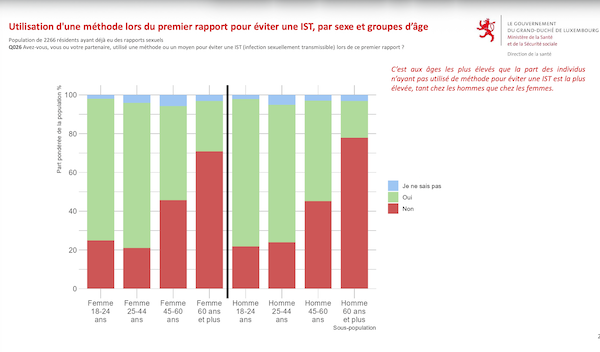
 Use of a method during first sexual intercourse to prevent an STI, by sex and age group;
On Monday 6 July 2026, the Health Directorate of Luxembourg's Ministry of Health and Social Security presented the results of the first national survey on affective and sexual health (SAS), carried out in 2025 among 2,371 residents aged eighteen and over.
According to the ministry, the survey provided national data enabling a better understanding of the realities, needs and behaviours of the population in terms of affective and sexual health. It highlighted progress but also significant challenges in areas such as the prevention of sexually transmitted infections (STIs), contraception, consent, sexual violence and the fight against discrimination.
Data showed that the first sexual intercourse most often took place between the ages of sixteen and eighteen, for almost one person in two. Eighty-five percent of respondents stated that this first sexual intercourse had been desired at that time.
The survey also showcased that respect for diversity remained a societal issue. While the vast majority of respondents defined themselves as heterosexual, 10% reported a sexual orientation other than heterosexual and 1% of respondents reported a gender identity different from the categories of man or woman. Above all, 12% of those surveyed indicated that they had already experienced negative remarks, questions or judgements related to their sexuality or the expression of their gender.
15% of those surveyed stated that they had already contracted an STI during their lifetime. Respondents generally believed they had good knowledge of STIs, with 84% considering themselves well informed on the subject. However, certain preventive behaviours still needed improvement. During the previous twelve months, among those aged eighteen to 24, only 39% stated that they had systematically used protection against STIs with each of their partners. Finally, 31% reported having undergone a screening test during those twelve months.
The survey showed that contraception was generally integrated into first sexual intercourse: 68% of respondents indicated that they had used a method of contraception during their first sexual intercourse. Furthermore, during the previous twelve months, 26% reported using the (male) condom and 17% the pill. While 91% considered themselves well informed about contraception, more than one third of respondents (38%) were unaware that contraception was now free of charge. Among all, 89% indicated that they are satisfied with their contraception.
The survey also showed that, during their lifetime, 17% of the women surveyed reported having had at least one voluntary termination of pregnancy (abortion).
34% of respondents stated that they had already experienced pressure from a partner to have sexual intercourse, a situation even more frequent among women and people with disabilities. Furthermore, 31% indicated that they had already experienced unwanted sexual intercourse under pressure from their partner.
The survey also revealed that, among people reporting having been victims of rape, 60% stated that they had spoken about it to a trusted person, while 15% reported having lodged a complaint.
Among people who completed all or part of their schooling in Luxembourg, 44% stated that they had received education on affective and sexual health, of whom 27% had received it only once during their education. Among those who received health education, 49% considered that these lessons had answered their questions only slightly or moderately (score ≤ 4/10). Health professionals were the main sources of information, particularly gynaecologists and general practitioners.
"This survey gives us a clear picture of the expectations and realities experienced by the population. These results provide a solid basis for strengthening our actions and promoting affective and sexual health based on respect and consent," emphasised Martine Deprez, Luxembourg’s Minister of Health and Social Security.
The ministry said that several measures had already been implemented to strengthen sexual and reproductive rights, including the programme providing free contraception, the inclusion of the freedom to have abortion and the removal of the mandatory reflection period before a voluntary termination of pregnancy.
Furthermore, actions included the development of educational and awareness-raising tools such as "Let's Talk about Sex!", the integration of affective and sexual health into the new curriculum for fundamental education, and the strengthening of support for victims of violence through the National Centre for Victims of Violence (CNVV), which provides care 24 hours a day, seven days a week.
The results of the SAS survey were presented during the event "Affective and Sexual Health: Networking and Presentation of the First National Survey", co-organised with the National Reference Centre for the Promotion of Affective and Sexual Health (Cesas).