 Credit: OFP, ODC / Ministry of Economy
On Wednesday 16 March 2022, Luxembourg's Ministry of Economy published a new edition of the half-yearly report from the Price Formation Observatory (L'Observatoire de la formation des prix - OFP).
The OFP is part of the Observatory of Competitiveness (Observatoire de la compétitivité - ODC), a department of the Ministry of Economy with the goal to help the government and social partners to define guidelines and content of policies that are favourable and compatible with long-term competitiveness.
The report includes an analysis of the evolution of inflation in Luxembourg in 2021, a comparison of inflation with neighbouring countries, an analysis the evolution of administered prices for 2021 and a reminder of the work carried out by the OFP since its creation.
The committee for monitoring the work carried out by the OFP met on Monday 14 March 2022. This committee, which is made up of representatives of consumers, employers' organisations and the government, is responsible for the study, analysis and reports of the Price Formation Observatory.
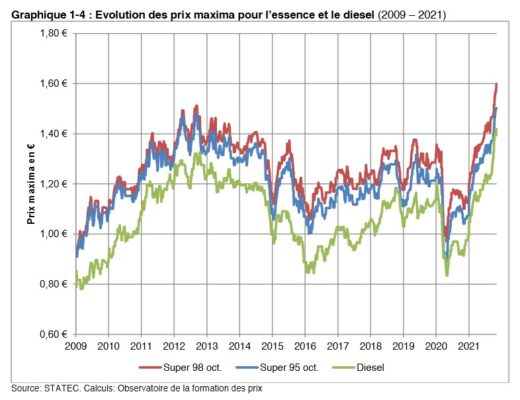
Annual inflation climbed to 2.5% in 2021 against 0.8% in 2020 mainly due to the rise in the price of petroleum products (up 27.6%) caused by the economic recovery and the catch-up in Brent price, which had fallen the previous year due to the COVID-19 pandemic, as well as the introduction of the CO2 tax in January 2021 and the increase in the prices of services (up 1.5% compared to 1.3% in 2020), in particular following the triggering of the automatic wage indexation in October 2021.
The categories that contributed the most to the increase in the price of services are those of maintenance and repairs (up 5.2%) as well as financial services (up 5.2%) and women's hair salons (up 3.6%). However, it was energy prices that rose sharply in 2021 (up 18.8%), thus driving up inflation. In particular, the price of heating oil (up 50.1%), diesel (up 25.1%), petrol (up 22.6%) as well as liquid gas (up 19.0%) saw the biggest increases. Conversely, electricity prices fell by 0.2% after rising by 9.8% in 2020.
The health crisis has impacted inflation which is on the rise everywhere in the European Union (up 2.5%). Luxembourg inflation in 2021 slightly exceeded the European average and that of France, but it remains lower than that of other neighbouring countries, i.e. Belgium, Germany and the Netherlands.
The beginning of 2022 is marked by inflation which is further increasing, particularly in view of the current prices of energy, food and raw materials.