 Credit: World Competitiveness Yearbook, IMD
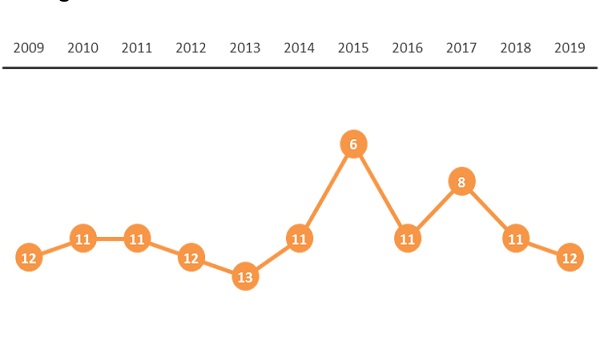
Luxembourg has ranked 12th among 63 countries for competitiveness in the latest World Competitiveness Yearbook, run by the Swiss International Institute for Management Development (IMD).
Despite this good result, Luxembourg has dropped one place from 2018 in these rankings and is moving away from the top 10, of which it had been part in 2015 and 2017. Moreover, work remains to be done if it is to become one of Europe's leaders in competitiveness - the Grand Duchy was the 7th most competitive European country.
According to the Luxembourg Chamber of Commerce, listening more to entrepreneurs could be the key to improving this ranking. In this regard, business leaders have argued for a framework that is both predictable and dynamic, based on an attractive international tax regime and an efficient legal and administrative environment. In addition, it should help to attract and retain talent.
Indeed, the Chamber of Commerce, a partner of the State for the implementation of a policy in favour of a competitive economy, has underlined that the three most competitive countries in 2019 - Singapore, Hong Kong and the United States - are all recognised for listening to entrepreneurs. These countries were followed in the top 10 by Switzerland, the United Arab Emirates (which was only 15th in 2016), the Netherlands, Ireland (up five places), Denmark, Sweden and Qatar. Luxembourg ranked 5th among the EU member states but left the top 10 countries with less than 20 million inhabitants (11th).
Although the Grand Duchy plays an important role in the exchange of commercial and financial services and benefits from a qualified and international workforce, as well as the stability of its institutional framework, the Chamber of Commerce has noted that its competitiveness seems to be slowly eroding in certain areas: taxation, labour costs, office prices, quality of infrastructure, etc. These points of attention were highlighted by the statistical indicators used in the IMD study and by the responses to the survey addressed to the heads of Luxembourg companies.
Luxembourg's top five "key attractivness indicators" remained identical to those of 2018 according to the entrepreneurs surveyed: policy stability & predictability; dynamism of the economy; business-friendly environment; competitive tax regime; effective legal environment. However, according to the IMD, the five challenges in 2019 for Luxembourg's competitiveness are: responding to the important need for talent through training and an attractive framework for foreign workers; restoring fiscal competitiveness through an ambitious fiscal roadmap (including, inter alia, statutory rates, start-ups and intellectual property); improving the effectiveness of public governance through digitisation; promoting a more agile and flexible work environment with strong empowerment of sectors and companies in social dialogue; making the education system more inclusive and valuing the potential of each student.