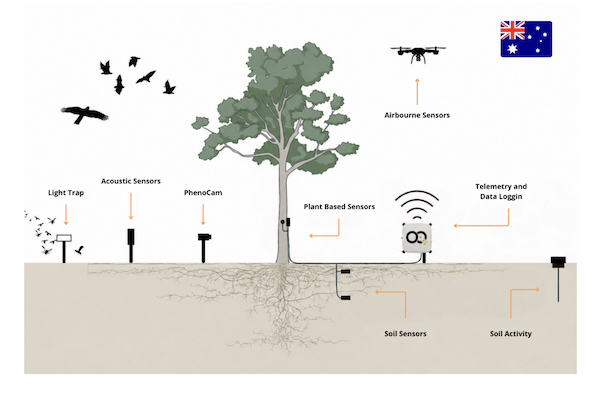
 OQ Technologies "Space-Enabled Smart Sensing for Forest Monitoring" project;
Credit: Brendan Choat
OQ Technologies "Space-Enabled Smart Sensing for Forest Monitoring" project;
Credit: Brendan Choat
On Thursday 17 September 2026, Luxembourg-based satellite connectivity provider OQ Technology announced its first project in Australia with its Space-Enabled Smart Sensing for Forest Monitoring project.
According to the company, the project is one of five collaborative projects awarded funding through NSSN Grand Challenge Fund 2026. The collaborative initiative brings together the NSW Smart Sensing Network (NSSN), Western Sydney University, University of NSW (UNSW), the NSW Space Research Network (SRN), Scenic World, Blue Mountains World Heritage Institute and OQ Technology.
OQ Technology said the collaboration builds on prior engagement between OQ Technology, the NSW Space Research Network (SRN), and Western Sydney University, and has been brought together through the NSSN Grand Challenge Fund to deliver an integrated research and industry partnership.
The project will deploy advanced environmental sensor networks connected through OQ Technology’s low-Earth-orbit satellite NTN IoT infrastructure to enable real-time monitoring of forests and ecosystems in remote or difficult-to-connect areas. The initiative will support improved visibility of ecosystem health, climate stress, biodiversity activity and natural hazard risk in the Greater Blue Mountains region of New South Wales.
OQ Technology noted that Australia’s natural forests and agroforestry sectors face growing pressure from bushfire, drought, flood, biodiversity decline and climate variability. At the same time, commercial forestry, carbon farming and natural capital projects increasingly require trusted measurement, monitoring and verification frameworks to support regulatory compliance, project performance and investor confidence.
The project directly addresses these needs by combining smart sensing, research validation and satellite-enabled communications to support continuous monitoring of:
• tree water stress;
• soil moisture;
• microclimate conditions;
• biodiversity activity;
• forest health and ecosystem condition;
• climate and drought stress indicators;
• post-fire and extreme-weather recovery.
For OQ Technology, the project provides a significant Australian reference case for standards-based satellite IoT services, by demonstrating how satellite-enabled connectivity can support low-power sensing applications across sectors where long-term monitoring, low maintenance and wide-area reach are essential.
The project also aligns with OQ Technology’s broader roadmap toward scalable direct-to-device satellite IoT connectivity. Over time, this approach has the potential to reduce field infrastructure requirements, lower installation and maintenance costs, and enable faster roll-out of remote sensing networks across large geographic areas.
Omar Qaise, Founder and CEO of OQ Technology, said: “This project demonstrates the growing importance of satellite-enabled IoT infrastructure in addressing some of the world’s most pressing environmental and climate resilience challenges. Australia is an ideal environment to showcase how satellite communications can support critical monitoring applications in remote and climate-sensitive regions.”
“OQ Technology Australia was established to enable NTN IoT and D2D in Australia. We are proud to collaborate with leading Australian research institutions and industry networks on a project that combines advanced sensing, space technology and environmental science into a scalable operational capability. The long-term opportunity is not only to monitor forests more effectively, but to build a model for resilient, standards-based connectivity that can support remote industries, public infrastructure and climate adaptation more broadly.”
Professor Brendan Choat from Western Sydney University said: “Continuous, real-time monitoring of ecosystem stress is becoming increasingly important for forestry, biodiversity conservation, carbon markets and climate adaptation. By integrating advanced sensors with satellite-enabled communications, we can now monitor ecosystems in locations that were previously very difficult to reach or connect.”
Dr Tomonori Hu, Environment & Agriculture Theme Leader, NSSN said: "The NSSN Grand Challenge Fund is designed to bring together the right partners to solve complex challenges through smart sensing. This project combines leading expertise in environmental science, satellite communications and sensing technologies to create a scalable solution that will improve how we monitor Australia's forests while strengthening our capability in resilient, remote monitoring."
Maurice Borer, Business Development Manager – Industry Engagement at SRN, said: “This project demonstrates the role SRN can play in catalysing strategic industry–research partnerships and translating emerging space-enabled technologies into practical outcomes aligned with Australia’s national science and civil space priorities. It also highlights how coordinated ecosystem engagement can create new international collaboration pathways.”