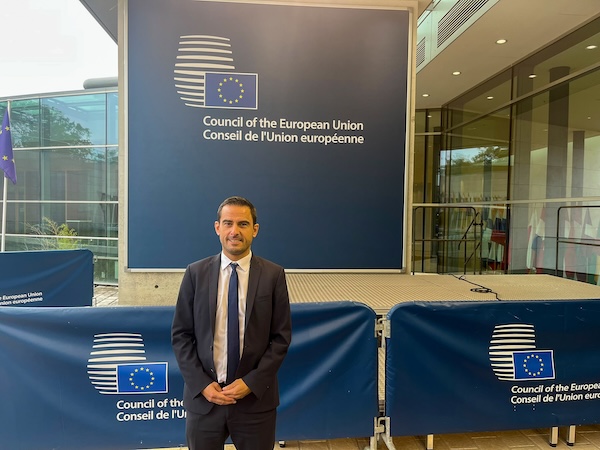
 Max Hahn, Luxembourg's Minister for Family Affairs, Solidarity, Living Together and Reception;
Credit: MT/MFSVA
On Monday 19 October 2026, the Employment, Social Policy, Health and Consumer Affairs (EPSCO) Council met in Luxembourg, with Luxembourg's Minister of Labour, Marc Spautz, and Minister for Family Affairs, Solidarity, Living Together and Reception, Max Hahn, attending the meeting.
The meeting focused on housing exclusion, equality, non-discrimination and the future of employment in the European Union (EU).
According to Luxembourg's Ministry of Labour and Ministry of Family Affairs, Solidarity, Living Together and Reception, Minister Hahn joined his counterparts in endorsing the Council recommendation on combating housing exclusion, including homelessness, as well as the Council conclusions on equality as a driver of economic growth and competitiveness.
Minister Hahn then participated in a discussion on progress and future measures to promote equality and non-discrimination at national and European levels. Building on its ambitious reform agenda implemented in recent years, Luxembourg called for gaps in the EU's legal framework on non-discrimination and equality to be addressed, ensuring that every EU citizen benefits from a harmonised level of protection against discrimination across all EU Member States.
Minister Spautz took part in a debate on a legislative initiative concerning quality jobs in the EU, which the European Commission is expected to publish in December 2026, noted the ministry. He and his counterparts exchanged views on several topics, including the use of artificial intelligence (AI) in the workplace, the right to disconnect and teleworking.
According to the ministry, Minister Spautz also stressed that any approach to teleworking must take into account the specific characteristics of Luxembourg's labour market, particularly its high proportion of cross-border workers. He reiterated that any changes to the European framework must reflect these circumstances and remain consistent with the tax agreements negotiated with neighbouring countries.