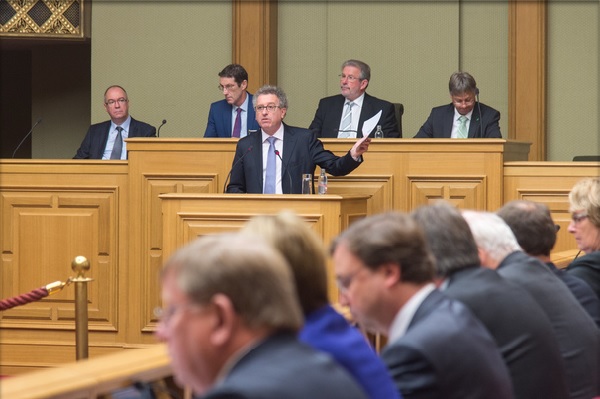
In his 2016 budget address to the Chambre de Deputés on Wednesday, Luxembourg's Minister for Finance, Pierre Gramegna, presented first the underlying framework for the budgetary choices and changes.
Firstly, the population of the Grand Duchy, in addition to the 162,000+ cross-border workers who live in neighbouring countries and commute to work in Luxembourg during week-days, is currently 563,000, having risen from 455,000 in 2004. Over the following years, the government expects the population to grow even more and to reach 604,000 in 2018 and 618,000 in 2019.
For 2016, the state expects to raise €16,106 billion (up 5.4% on 2015), made up of €6.244 billion from indirect taxes, €7.277 million from direct taxes, €503 million from public institutions, €399 million from propriety revenue, €891 million from social contributions, €177 million from rents and €675 million from other sources.
On the expenses side, €4.059 billion (approx 25% of the budget) is expected to be spent on social security, €3.723 on salaries of state employees (approx 20%), €2.241 billion on direct and indirect investments (up almost €300m from 2015), €1.338 billion on operational costs, €1,250 on municipal administrations, €1.699 billion on social services, €635 million on subsidies and subventions, €172 million on interest repayments and €1.623 billion on other revenue transfers. In total, the 2016 budget expects to spend €16.740 billion in 2016 (up 4.6% on 2015).
Luxmbourg's public debt is expected to jump next year following a year of consolidation, and keep climbing to an expected €14.518 billion by 2019; however, in keeping with estimated population growth, this would rise from the current 23% to just 24.5% of GDP. Luxembourg will continue to remain one of the least indebted countries in the world: the 2016 deficit of €634m is compared against a deficit of €817m for 2015.
2016 will see the number of state employees grow by 750, with half expected to be recruited in education.
In his speech, Minister Gramegna highlighted 5 priority areas:
1. Supporting Economic Growth
2. Investing in Citizens' interests
3. Strengthening the Social Fabric (children, unemployment, young families, farmers)
4. Climate Change, including establishing a Climate Energy fund (€120 million)
5. International solidarity
In a change to the norm, Minister Gramegna presented the 2016 state budget from a USB key instead of distribution printed copies.
Photo by Charles Caratini, copyright SIP