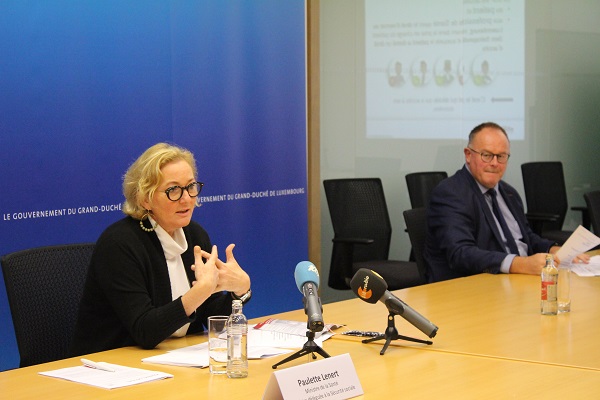
 L-R: Paulette Lenert, Luxembourg's Minister of Health; Romain Schneider, Minister of Social Security;
Credit: MSS
L-R: Paulette Lenert, Luxembourg's Minister of Health; Romain Schneider, Minister of Social Security;
Credit: MSS
During a press conference on Tuesday, Luxembourg's Minister of Health, Paulette Lenert, and Minister of Social Security, Romain Schneider, accompanied by the President of the Management Board of eSanté Agency, Christian Oberlé, presented the "shared medical file" (dossier de soins partagé - DSP) and its accompanying advertising campaign.
With the completion of the pilot phase at the end of December 2019 and the entry into force on 1 January 2020 of the Grand-Ducal regulation specifying the terms and conditions for setting up the DSP, the eSanté Agency is gradually deploying the shared medical file to all persons affiliated with Luxembourg social security.
Shared medical files serve as a free, personal and secure electronic health record that centralises essential patient health data in one place. A patient's file is built up by health professionals over time or by the patient him / herself who supply it with documents relating to the latter's health. Perceived advantages include the centralisation of essential health information, meaning patients no longer need to memorise them, and, in the event of a medical emergency, the professionals taking care of a patient have direct access to their essential data.
The shared medical file also facilitates data sharing between healthcare professionals and direct access to data, if the patient allows it. This is aimed at facilitating the coordination of care and promoting optimal care adapted to the patient's state of health. Patients can also express their willingness to be an organ donor through their file.
Health Minister Paulette Lenert noted: "The patient becomes more than ever an actor in his health and keeps control of access and the nature of the exchange of his data. The DSP therefore allows patients to play a more active role in their healthcare journey, thus promoting the “patient empowerment” coveted by patients, associations representing the interests of patients and national and international health authorities”.
The eSanté platform currently hosts 625,564 shared medical files. Social Security Minister Romain Schneider added: “Until the beginning of next year, the deployment of the DSP for the 850,000 insured persons [through the CNS] will be completed and each insured person will therefore have access to their own electronic shared care file; the next challenge is to power the DSP with the essential documents of the insured person".
At the press conference, the Health Minister confirmed that plans were underway for the automated payment of medical bills through the DSP by 2023.
The widespread deployment of the shared medical file will be accompanied by an advertising campaign aimed at the general public. Minister Romain Schneider specified: "With the communication campaign, we want to make the DSP better known to the general public and communicate about its many advantages with the aim of encouraging the population to actively use its DSP and to unite [them] around the DSP and the issues involved". The campaign will be broadcast around mid-October 2020.