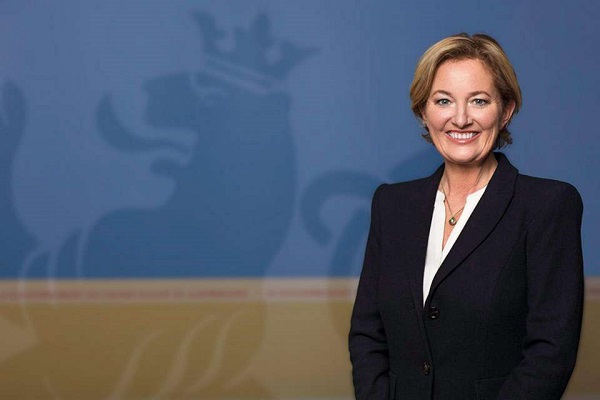
 Paulette Lenert, Luxembourg's Minister of Health;
Credit: © SIP / Yves Kortum
Paulette Lenert, Luxembourg's Minister of Health;
Credit: © SIP / Yves Kortum
During a press conference on Friday 14 August 2020, Luxembourg's Minister of Health, Paulette Lenert, reviewed the key elements of the prevention and control strategy in the event of a resumption of the COVID-19 pandemic in Luxembourg entitled "Zesumme geint COVID-19".
The minister reviewed the evolution of the pandemic with a strategy of lockdown and deconfinement in several phases, which has paid off before the country experienced an upsurge in new infections in early July. Currently, a downward trend in the number of cases testing positive for COVID-19 can be noted since the week of 20 July, with less than 50 cases per 100,000 inhabitants (47.44) for the period from 3 to 9 August.
Current priorities
Minister Lenert said "While my top priority will always be the protection of public health, it is just as important to me to provide COVID patients with high quality care, while keeping our health system functioning properly. These ambitions must go hand-in-hand with a safe working environment for health and care staff.”
It is also about maintaining socio-economic life, avoiding a second lockdown, allowing maximum normality and health safety in the daily life of citizens and taking action against social exclusion. The prevention and control strategy in the event of a resumption of the pandemic is based on 5 basic measures: information, prevention, support, screening and management of COVID patients.
Medical and social care
The proper functioning of our health system and its capacity to face the challenges of the crisis constitute an essential pillar in the fight against the pandemic.
As announced by the Minister, hospitals are prepared for the medical management of COVID patients in normal and intensive care. The objective of the preparation is to gradually increase in a homogeneous way over the whole of the country in order to avoid a de-programming of the medico-surgical activity, and therefore to guarantee an offer of care for the citizens as close as possible to usual.
"I am particularly pleased that, in consultation with the CNS and the FHL, an additional healthcare grant has been retained, making it possible to cope with the work overload and the new hospital organisation induced by COVID. This allocation concerns normal care, intensive care, adult and paediatric emergencies, as well as the National Service of Infectious Diseases and the National Specialised Paediatric Service”, underlined Minister Lenert.
Regarding the follow-up care of COVID patients after an acute hospital stay, additional management possibilities have been identified.
A scaling-up plan has also been established for primary care around 3 axes:
1 - Teleconsultations for suspected COVID provided by general practitioners and specialists;
2 - COVID consultation centres (CCC) for the medical examination and nasopharyngeal swab of patients suspected of COVID;
3 - Advanced care centres (CSA).
A first COVID Consultation Centre (CCC) is being set up in Kirchberg, in the premises of the former Luxembourg National Library. If necessary, this centre will be activated from the end of this coming week. It is a centre for receiving patients with suspicious signs of COVID-19 infection.
In addition, the concept of care aimed specifically at people in precarious situations will be extended and developed further.
Screening: special “summer 2020” testing
Together with contact tracing and compliance with preventive measures, the testing strategy is an integral part of Luxembourg's policy against the SARS-CoV-2 virus. Large-scale testing for COVID-19 will continue throughout the holiday season in an effort to protect public health and contain the pandemic.
Implemented in collaboration with the Luxembourg Institute of Health (LIH), this summer's test approach is targeted and reactive and is in line with a concern for continuity with respect to the first phase of large scale testing, which expired on 27 July. The second phase will begin in September with a long-term perspective, at least until the first quarter of 2021, with an emphasis on strategic monitoring of the population and the identification of local upsurges.
The gap between the two phases will be bridged by an extension of large-scale testing to cover the month of August and the beginning of September. Its orientation falls within the particular context of the holiday period and the upsurge in infections seen from mid-July.
“Household” screening: Faced with the observation that recently-identified new cases are primarily the result of intra-family contaminations, households will be invited for large scale testing according to a well-defined grid pattern depending on the location of the infections.
“Sectorial” screening: Invitations will continue to be sent to people exposed to a higher risk of contamination, such as health and care personnel, for example.
Special "Travellers": The test system will also give particular importance to travel. Thus, people who must or wish to travel to a country requiring them to protect themselves from a negative test have the possibility of being tested for free via a procedure on MyGuichet.lu.
Those returning from their plane trip will be able to take advantage of a free test upon arrival at Luxembourg airport. Those returning from their trip by another means of transport will be able, from 17 August, to make an appointment for a free test on their return, via MyGuichet.lu.
Special "Collective leave": In collaboration with the UEL, the Chamber of Trades and the Federation of Craftsmen, the Ministry of Health has also considered a representative screening campaign in companies in certain sectors upon return from collective leave. The chosen approach will provide a representative overview of potential outbreaks of infection in companies.
Special "Back to school": Finally, in order to ensure a smooth resumption of schooling, primary and secondary school students and staff will receive invitations to be tested in early September.
In the event of experiencing symptoms, it will obviously always be possible to have a PCR test prescribed by a doctor carried out.