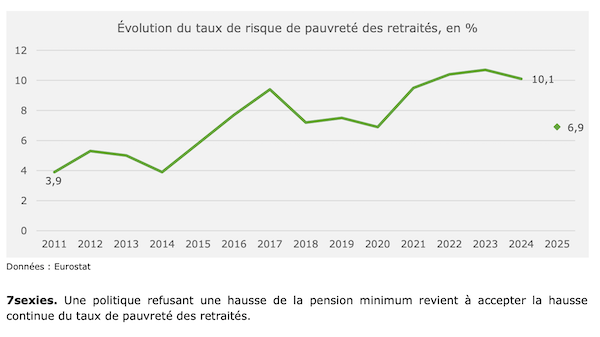
 Evolution of the At-Risk-of-Poverty Rate Among Pensioners;
Credit: Eurostat
Evolution of the At-Risk-of-Poverty Rate Among Pensioners;
Credit: Eurostat
On Wednesday 14 October 2026, Luxembourg's Chamber of Employees (Chambre des Salariés - CSL) announced its decision to draft a bill to structurally increase the level of the minimum pension, aiming to enable pensioners to lead a decent life after a full insurance career.
According to the CSL, “even a 40-year career is currently not enough to guarantee an adequate minimum pension”, either in relation to the reference budget determined by STATEC or the at-risk-of-poverty threshold for pensioners.
The CSL's proposal would increase the minimum pension from 90% to 100% of the reference amount set by the Social Security Code. This change would represent an 11.1% increase in the gross minimum pension. For a full career, at the current index and the revaluation factor applicable in 2026, the amount would rise from €2,436.04 to €2,706.71 gross per month, representing a monthly increase of €270.67. The proposed date of entry into force is 1 January 2027.
The CSL highlighted the gap between the minimum pension and STATEC's reference budget for a decent standard of living, which stood at €2,724 net per month in the first half of 2026. For a taxpayer in tax class 1a, the net minimum pension falls 12% below this amount.
Based on 2024 income, the net minimum pension was also 12.2% below the at-risk-of-poverty threshold, leading the CSL to argue that even a 40-year career does not guarantee financial security in retirement.
According to the CSL, raising the minimum pension would particularly benefit women, whose average pensions for careers spent entirely in Luxembourg are 40.8% lower than men's. Luxembourg also recorded the third-largest gender pension gap among residents in a European comparison in 2023.
Women account for nearly 80% of recipients of the minimum pension supplement, meaning an increase would primarily benefit female pensioners.
The CSL also highlighted the widening gap between the net minimum wage and minimum pension. It attributed this to tax credits for low-paid workers that do not generate pension entitlements and the planned individualisation of taxation in 2028, which is expected to benefit employees more than pensioners.
According to its calculations, the net minimum wage could exceed the net minimum pension by almost 6% in 2028, prompting the organisation to call for measures to preserve pension adequacy.
In the field of social assistance for the most disadvantaged people, the CSL expressed support but maintained that the government's proposed financial assistance for elderly people should not replace an increase in the minimum pension.
The organisation argued that pensioners should not have to turn to a social welfare office to secure a decent standard of living after 40 years of insurance contributions. It considers social assistance a supplementary measure intended to address specific needs.
The CSL also noted that social assistance procedures can be perceived as stigmatising, resulting in some eligible people not claiming benefits. By contrast, an increase in the minimum pension would apply automatically to eligible recipients.
Furthermore, the organisation highlighted that social assistance excludes non-resident pensioners, including former cross-border workers, who would benefit from an increase in the minimum pension.
The CSL estimated that the proposed increase would cost slightly more than €30 million annually, representing approximately 0.4% of pension expenditure. According to the organisation, the measure would improve the financial situation of affected households.
The CSL also noted that increasing the minimum pension was among the few measures to receive consensus during the public consultation and expert group discussions held as part of the 2025 pension reform.
The organisation therefore proposes raising the minimum pension to €2,706.71 gross per month based on 2026 parameters, or €2,749.81 using the revaluation factor applicable in 2027.