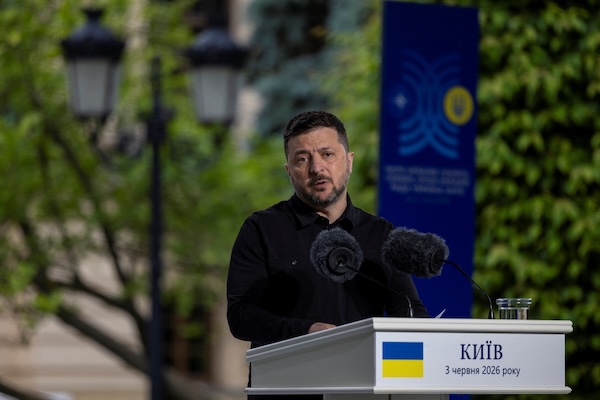
 Ukrainian President Volodymyr Zelensky speaks during a joint press conference with NATO Secretary General Mark Rutte after talks, amid Russia's attack on Ukraine, in Kyiv, Ukraine, 3 June 2026;
Credit: Reuters/Thomas Peter
Ukrainian President Volodymyr Zelensky speaks during a joint press conference with NATO Secretary General Mark Rutte after talks, amid Russia's attack on Ukraine, in Kyiv, Ukraine, 3 June 2026;
Credit: Reuters/Thomas Peter
KYIV (Reuters) - On Tuesday 21 July 2026, President Volodymyr Zelensky named a young major general, Mykhailo Drapatyi, as the commander-in-chief of Ukraine's military after days of street protests, marking the biggest shake-up in the country's military leadership since its war with Russia began.
Zelensky replaced Oleksandr Syrskyi, 60, with Drapatyi, 43, a respected and experienced commander who led the country's land forces from 2024 to 2025 and is described as a general of a new generation.
Last week, Zelensky's government reshuffle and dismissal of tech-savvy reformist Defence Minister Mykhailo Fedorov, 35, after just half a year in office, stirred concerns among analysts that Ukraine's recent battlefield momentum could be lost.
Ukraine has been trying to gain the upper hand in the war by heavily striking Russia's energy sector - its main source of budget revenue - and logistics.
"The operations of the Ukrainian Defence Forces are ongoing and must continue steadily. Ukraine's plan for long-range sanctions and our program of middle-range strikes will be carried out with absolute precision," Zelensky said as he introduced Drapatyi.
The surprise government reshuffle last week led to a political crisis that exposed weaknesses in Ukraine's domestic governing due to the lack of elections during the war.
Drapatyi seen a voice of change
Drapatyi's appointment follows days of protests sparked by what critics said were poorly explained changes in government, and reflects the position of Ukrainians who see the use of technology as key to winning the war. His career was shaped by fighting Russian troops for more than a decade.
Syrskyi played a key role in Kyiv's defence in the early days of the war and has been in his post since early 2024.
But he has also faced harsh criticism for a rigid command style which some service members have said resulted in unjustifiably high troop losses.
Criticism of him has surfaced periodically, but last week's reshuffle brought out into the open the deep divisions in the Ukrainian defence leadership.
Critics had accused Zelensky of favouring Syrskyi over Fedorov in a conflict between the two, and analysts questioned whether Ukraine could win the war, now well into its fifth year, under Syrskyi's leadership.
"I will work responsibly, with full focus, and with respect for the people who are defending our country today," Drapatyi said on Facebook.
Fedorov, whose return to office was one of the protesters' main demands, welcomed the appointment.
"This is a breath of fresh air and a new source of hope in the fight of free people for freedom and justice. It is the voice of change that could no longer be ignored," Fedorov said on X.
Dmytro Koziatynskyi, a war veteran and one of the organisers of the protests, said on X that Drapatyi's appointment was a "gift" as he celebrated his birthday the same day the appointment was announced.
Fedorov's fate remained unclear. Zelensky said on Tuesday that he offered him a "decent post" to oversee the technological component of the state, but the former minister has previously said that he only wants his old job back.
Last week, Zelensky chose Yevhenii Khmara, who was acting head of Ukraine's domestic security service, to become acting defence minister.
"We all want the same thing: to defeat the enemy and create the conditions - on the front line and through pressure on Russia - that would allow us to force Russia into peace," Zelensky added.