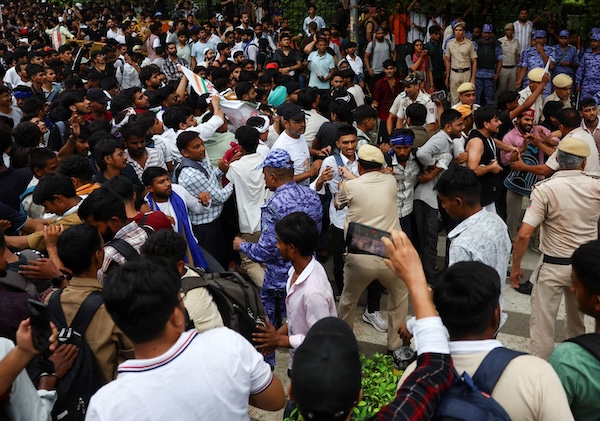
 Police restrain people near Jantar Mantar ahead of a march to Parliament led by India's Cockroach Janta Party, demanding the resignation of Education Minister Dharmendra Pradhan over exam paper leaks, in New Delhi, India, 20 July 2026;
Credit: Reuters/Anushree Fadnavis
Police restrain people near Jantar Mantar ahead of a march to Parliament led by India's Cockroach Janta Party, demanding the resignation of Education Minister Dharmendra Pradhan over exam paper leaks, in New Delhi, India, 20 July 2026;
Credit: Reuters/Anushree Fadnavis
NEW DELHI (Reuters) - On Monday 20 July 2026, supporters of India's youth-led "cockroach" movement were caned by police as they sought to march on parliament in the capital New Delhi, despite authorities denying permission for the protest.
The months-old movement and the planned protest are seen as the biggest public challenge to Prime Minister Narendra Modi in his third term in office, drawing millions of supporters on social media before broadening its appeal.
A police decision to forcibly move hunger-striking activist Sonam Wangchuk to hospital on Saturday 18 July 2026 has galvanised the movement, with thousands of supporters arriving through the night at the protest site of Jantar Mantar in the heart of New Delhi for the march on the opening day of parliament's monsoon session.
Delhi police held meetings with Cockroach Janta Party (CJP) members, but no consensus had yet been reached, Sachin Sharma, Delhi's Deputy Commissioner of Police, told Reuters.
"The protest site has already run out of space and this can lead to an untoward situation," he said, adding that there were around 10,000 protesters on Monday morning.
Scores of police and paramilitary security personnel were also deployed at the site, threatening a standoff close to parliament if the march goes ahead.
Television visuals showed police caning some protesters in a heavily barricaded area.
Delhi Police denied any use of force and said the "protest is being handled professionally."
Protesters chanted slogans as they arrived peacefully in a rainy central Delhi.
"Quit, quit," they chanted. "Dharmendra Pradhan quit", "Narendra Modi quit", they chanted in Hindi referring to the education minister as well as the prime minister.
"The administration is trying to open talks with the government... They have come very late, but we have opened our hearts and said that we are willing to talk to them," Saurav Das, chief CJP spokesperson, told the ANI news agency.
The CJP movement began after national medical school entrance test papers were leaked in May, affecting more than 2 million students as it forced them to sit the test a second time.
"All these leaders in power are illiterate and I am here to protest because we do not want question papers to leak," said Adi Nathan, 21, a student from Meerut city, about 100 km from the capital. "This should come to an end."
Mohammed Tabrez, 22, a student preparing for competitive examinations that allow students admission into professional courses or jobs, said he had come from Amroha in Uttar Pradesh state, about 165 km away.
"We want this corruption to end," he said. "We want all the frauds in paper leaks, in competitive examinations to end and this is the reason I have come here."
Activist sets terms to end his fast
The CJP initially drew support largely online, amassing 22 million followers on Instagram within days but has since drawn support from some opposition parties.
CJP founder Abhijeet Dipke and his supporters began a sit-in last month seeking the resignation of Pradhan. Wangchuk joined them on June 28, launching an indefinite hunger strike at the site.
In a handwritten note from hospital posted on his X account on Monday, Wangchuk said he would end his fast if the government took responsibility for recent failures in the education system and for paper leaks, or if CJP protesters were allowed to reach parliament and lawmakers assured them they would take up the issues.
He said he would also end the hunger strike if lawmakers and leaders of various parties met him in hospital and gave him the same assurances since his health did not allow him to march on parliament.
The rise of the CJP reflects frustrations among young Indians over issues like high youth unemployment and frequent examination paper leaks, analysts say.
Unemployment in 2025 stood at 3.1% among those aged fifteen and above, government data shows, but was 9.9% for those from fifteen to 29. In urban areas it was 13.6%, and 8.3% in rural regions.