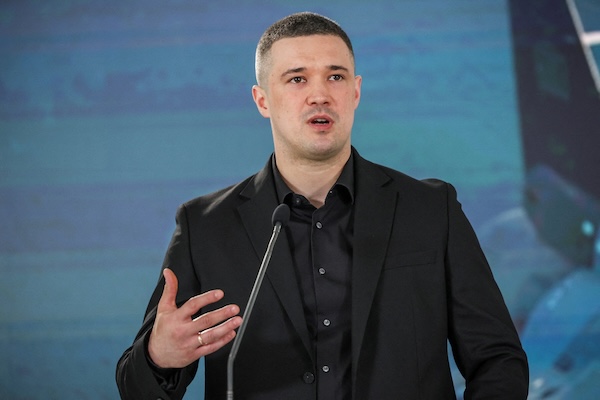
 FILE PHOTO: Ukraine's Minister of Defence Mykhailo Fedorov speaks at a joint press conference in Kyiv, Ukraine, 1 July 2026;
Credit: REUTERS/Alina Smutko/File Photo
FILE PHOTO: Ukraine's Minister of Defence Mykhailo Fedorov speaks at a joint press conference in Kyiv, Ukraine, 1 July 2026;
Credit: REUTERS/Alina Smutko/File Photo
KYIV (Reuters) - President Volodymyr Zelensky endorsed the head of the state energy company as Ukraine's new prime minister on Wednesday 15 July 2026 and lawmakers said he planned to replace his defence minister at a pivotal juncture in the war with Russia.
Some lawmakers and commentators expressed dismay at the departure of Defence Minister Mykhailo Fedorov, saying it would hurt Ukraine's war effort just as it was hitting Russia's oil industry and slowing the frontline advances of Moscow's forces.
Zelensky pushed out Prime Minister Yulia Svyrydenko this week after just a year in the job. Parliament accepted her resignation on Tuesday 14 July 2026 and is expected to vote on her successor on Thursday 16 July 2026. Zelensky has given little explanation for the move so far, apart from saying the aim is to refresh the leadership.
Speaking to reporters in Kyiv, Zelensky said the CEO of the state-owned energy company Naftogaz, Sergii Koretskyi, was the best candidate for prime minister because Ukraine's priority was preparing for the upcoming winter.
"The priorities are clear – preparing for winter," Zelensky said. "Therefore, following all the consultations, Sergii Koretskyi is surely the most prepared candidate for the post of prime minister of Ukraine."
Outgoing Prime Minister Yulia Svyrydenko's removal, after just a year in office, triggered the resignation of the whole government. Parliament names the prime minister and is likely to accept Zelensky's preferred candidate as prime minister, as his Servant of the People party controls a majority.
Focus on the defence ministry in wartime
But much of the focus on the government line-up was fixed on whether Zelensky would keep Fedorov, a 35-year-old tech expert, as defence minister nearly four-and-a-half years into the war with Russia.
Members of parliament, posting on social media after a meeting with the president, said he would appoint Ihor Klymenko, interior minister since 2023, to take on the defence portfolio.
Olha Vasylevska-Smahliuk, from Zelensky's ruling Servant of the People party, said that Klymenko would be put forward.
It was not immediately clear whether another government job would be offered to Fedorov, who during his six-month tenure as defence minister has led an ambitious campaign to transform Ukraine's outmanned army into a more efficient fighting force.
Some lawmakers said Zelensky's decision to replace Fedorov as defence minister would not help Ukraine's war effort.
Oleksandr Merezhko, the chair of parliament's Foreign Affairs Committee and a member of Zelensky's party, expressed disappointment.
"Fedorov… is highly respected amongst our international partners," he said on social media. "His name was associated with hopes for genuine reforms within the Ministry of Defence."
Maria Berlinska, a prominent volunteer and drone warfare advocate, said Fedorov's replacement was "one of President Zelensky's biggest mistakes."
"This decision by the president will not only cost us, it will cost us hugely. The price will be the lives and health of hundreds of thousands of people ... if not more."
Fedorov, writing on Telegram, said it had been "a great honour" to serve Ukraine and compiled two sets of objectives – those already achieved, including investments in drones and a revamp of procurement.
Others still to be completed included "organising the transformation of the Defence Ministry to the standards of NATO and common sense."
The episode threatens to further dent public and parliamentary trust in Zelensky's wartime leadership, just when Ukraine's fortunes appear to be reversing.
Ukraine also still faces critical challenges, including a shortage of air defences and manpower.
Russia says it is on course to achieve its goals in the war, now in its fifth year.
Fedorov's attempts to clean up defence procurement have angered parts of the establishment, his supporters say. He has also been criticised by some lawmakers for failing to deliver quickly enough on his pledge to reform recruitment.
Previously, as Ukraine's first minister for digital transformation, Fedorov streamlined key state services into a now-ubiquitous app.
As defence minister, he has been credited with boosting drone procurement and pursuing a data-driven strategy to wear down Russian forces.
Despite its success, Ukraine lacks US-designed interceptors to shoot down the ballistic missiles that have rained down on major cities such as Kyiv in greater numbers.
Officials are bracing for another winter of Russian strikes on the power grid.
Fedorov's reforms to alleviate the army's manpower shortage remain in progress, while abuse and mismanagement still plague the draft and some military units.
On the battlefield, Russia is grinding towards Ukraine's "fortress belt" of cities in the eastern Donetsk region that Russian President Vladimir Putin wants to occupy in full.