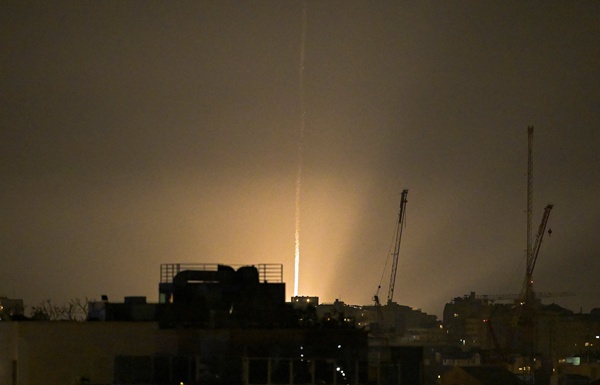
 Sky illuminates as an Iranian missile lands in Israel, amid the US-Israeli conflict with Iran, as seen from Tel Aviv, Israel, 12 March 2026;
Credit: Reuters/Dylan Martinez
Sky illuminates as an Iranian missile lands in Israel, amid the US-Israeli conflict with Iran, as seen from Tel Aviv, Israel, 12 March 2026;
Credit: Reuters/Dylan Martinez
DUBAI/TEL AVIV/WASHINGTON (Reuters) - Two tankers were ablaze in Iraqi waters on Thursday 12 March 2026 after what appeared to be Iranian strikes, the latest wave of attacks on oil and transport facilities across the Middle East, as Iran warned the world should be ready for oil to hit $200 a barrel.
Unleashed with joint US and Israeli air strikes on Iran almost two weeks ago, the war has so far killed around 2,000 people and thrown global energy markets and transport into chaos. The conflict has spread across the Middle East and prompted plans for a record release of strategic oil reserves to dampen one of the worst fuel shocks since the 1970s.
The United Nations Children's Fund (UNICEF) said more than 1,100 children had been killed or injured.
At a campaign-style rally in Kentucky ahead of November midterm elections in which his Republican party is trailing badly, US President Donald Trump said the United States had won the war but did not want to have to go back every two years.
"We don't want to leave early do we?" he said on Wednesday 11 March 2026. "We got to finish the job."
Iran has made clear it intends to impose a prolonged economic shock, with the spokesperson for Iran's military command saying in remarks directed at the US on Wednesday: "Get ready for oil to be $200 a barrel, because the oil price depends on regional security, which you have destabilised."
Oil prices, which shot up earlier in the week to nearly $120 a barrel before retreating, jumped almost 10% back above $100 a barrel in Asian trade on Thursday amid renewed fears about supply disruption. Wall Street's main share indexes fell and stocks in Asia followed suit.
Iranian explosive-laden boats appear to have attacked two fuel tankers in Iraqi waters setting them ablaze and killing one crew member after projectiles struck three merchant vessels in Gulf waters, port officials, maritime security and risk firms said.
"This appears to mark a direct and forceful Iranian response to the IEA's overnight announcement of a massive strategic reserve release aimed at cooling runaway prices," said Tony Sycamore, analyst at IG.
The International Energy Agency (IEA), made up of major oil consuming nations, on Wednesday recommended releasing 400 million barrels from global strategic reserves to dampen one of the worst oil shocks since the 1970s, the biggest such intervention in history.
Trump said the IEA decision "will substantially reduce oil prices as we end this threat to America and the world."
US Energy Secretary Chris Wright said Trump had authorised the release of 172 million barrels from the US Strategic Petroleum Reserve from next week.
Crucial oil route blocked
Iran also targeted fuel tanks at a facility in Bahrain's Muharraq, the interior ministry said, while drones struck oil storage facilities at Salalah port on Wednesday, Oman's state news agency reported. Saudi Arabia said it had also intercepted several drones heading towards its Shaybah oilfield on Thursday.
So far there has been no sign that ships can safely sail through the Strait of Hormuz, the now-blockaded channel along the Iranian coast that serves as a conduit for around a fifth of the world's oil.
On Wednesday, an Iranian military spokesperson said the Strait was "undoubtedly" under Iran's control and the G7 group of nations - the United States, Canada, Japan, Italy, the United Kingdom, Germany and France - agreed to examine the option of providing escort for ships so they can navigate freely in the Gulf.
Trump said US forces had knocked out 58 Iranian naval ships and that Iran was "pretty much at the end of the line."
He said the US would now "look very strongly" at the Strait of Hormuz, adding: "The straits are in great shape. We've knocked out all of their boats. They have some missiles, but not very many."
Trump said earlier ships "should" transit through the strait but sources said Iran had deployed about a dozen mines in the channel, further complicating the blockade.
Iranian weapons also struck elsewhere in the Gulf, with Kuwait reporting a drone hit a building in the south injuring two, while Dubai authorities responded to a drone that fell on a building near the vicinity of Dubai Creek Harbour.
Another container vessel reported being struck by an unknown projectile near the United Arab Emirates on Thursday, a maritime security authority said.
US and Israeli officials have said their aim is to end Iran's ability to project force beyond its borders and destroy its nuclear programme.
Trump and other officials have sent mixed messages about whether regime change was another goal after Supreme Leader Ayatollah Ali Khamenei was killed in initial strikes and replaced by his son Mojtaba Khamenei, who an Iranian official said was lightly wounded.
US intelligence indicates that Iran's leadership is still largely intact and is not at risk of collapse any time soon, according to three sources familiar with the matter.
ABC News said the Federal Bureau of Investigation had warned of Iranian drones potentially striking the US West Coast, although Trump said he was not worried that Iran might launch strikes on US soil.
The US State Department also warned that Iran and aligned militias may be planning to target US-owned oil and energy infrastructure in Iraq and warned that militias had in the past targeted hotels frequented by Americans.
The US military told Iranians to stay clear of ports with Iranian navy facilities, drawing a warning from Iran's military that if the ports were threatened, economic and trade centres in the region would be "legitimate targets".