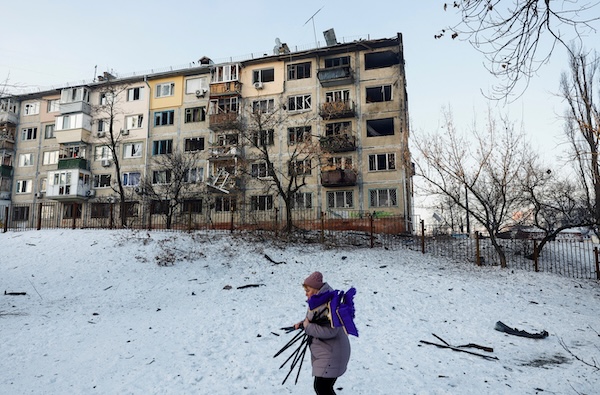
 A woman, who is a school employee, walks near the site of an apartment building hit by a Russian drone strike, amid Russia's attack on Ukraine, in Kyiv, Ukraine 3 February 2026;
Credit: Reuters/Valentyn Ogirenko
A woman, who is a school employee, walks near the site of an apartment building hit by a Russian drone strike, amid Russia's attack on Ukraine, in Kyiv, Ukraine 3 February 2026;
Credit: Reuters/Valentyn Ogirenko
KYIV (Reuters) - On Wednesday 4 February 2026, Ukrainian and Russian officials wrapped up a "productive" first day of new US-brokered talks in Abu Dhabi, Kyiv's lead negotiator said, as fighting in Europe's biggest conflict since World War Two raged on.
The two-day trilateral meetings come after Ukrainian President Volodymyr Zelensky said Russia had exploited a US-backed energy truce last week to stockpile munitions, attacking Ukraine with a record number of ballistic missiles on Tuesday 3 February 2026.
"The work was substantive and productive, focused on concrete steps and practical solutions," Rustem Umerov, the head of Ukraine's National Security and Defence Council, wrote on X.
A US official, who offered comment on condition of anonymity, also called the talks productive and said they would continue in the morning of Thursday 5 February 2026.
Zelensky, speaking in his nightly video address, said it was critical for the talks to lead to real peace and not offer Russia a new opportunity to continue the war. Ukraine's partners, he said, had to exert more pressure on Moscow.
"It must be felt now. People in Ukraine must feel that the situation is genuinely moving toward peace and the end of the war, not toward Russia using everything to its advantage and continuing attacks," Zelensky said.
Zelensky also said Ukraine expected the talks to lead to a new prisoner exchange soon.
The president, interviewed by French television channel France 2, said the number of Ukrainian soldiers killed on the battlefield as a result of the war with Russia was estimated at 55,000.
Zelensky had previously cited a figure of more than 46,000 Ukrainian servicemen killed in an interview with US television network NBC in February 2025.
Shortly after the talks began, Russian forces struck a crowded market in eastern Ukraine with cluster munitions, killing at least seven people and wounding fifteen, the Donetsk region's Governor Vadym Filashkin said.
Photographs released earlier in the day by the United Arab Emirates' foreign ministry showed the three delegations sitting around a U-shaped table, with US officials seated at the centre, including special envoy Steve Witkoff and US President Donald Trump's son-in-law Jared Kushner.
In Paris, diplomatic sources said French President Emmanuel Macron's most senior diplomat, Emmanuel Bonne, met Russian officials in the Kremlin on Tuesday.
One of the sources said the aim was to have dialogue on key issues, most importantly Ukraine, but did not give details beyond that.
Major differences remain on key points
Trump's administration has pushed both Kyiv and Moscow to find a compromise to end the four-year-old war, but the two sides remain far apart on key points despite several rounds of talks with US officials.
"The good news is that for the first time in a very long time, we have technical military teams from both Ukraine and Russia meeting in a forum that we'll also be involved in with our experts," US Secretary of State Marco Rubio said in Washington on Wednesday. "I don't want to say talks alone is progress, but it's good that there's engagement going on."
The most sensitive issues are Moscow's demands that Kyiv give up land it still controls and the fate of the Zaporizhzhia nuclear power plant, Europe's largest, which sits in a Russian-occupied area.
Moscow wants Kyiv to pull its troops out of all the Donetsk region, including heavily fortified cities regarded as one of Ukraine's strongest defences, as a precondition for any deal.
Ukraine said the conflict should be frozen along current front lines and rejects any unilateral pullback of its forces.
Kremlin spokesperson Dmitry Peskov said on Wednesday that Russian troops would keep fighting until Kyiv made "decisions" that could bring the war to an end.
Russia occupies about 20% of Ukraine's national territory, including Crimea and parts of the eastern Donbas region seized before the 2022 invasion. Analysts say Russia has gained about 1.5% of Ukrainian territory since early 2024.
"Russia is not winning its war against Ukraine," Ukrainian Foreign Minister Andrii Sybiha told online media outlet Liga on Tuesday.
Ukrainians oppose painful concessions
Polls show that the majority of Ukrainians oppose a deal that hands Moscow more land. Kyiv residents told Reuters they were sceptical that new talks would bring a major breakthrough.
"Let's hope that it will change (something), of course. But I don't believe it will change anything now," said Serhii, 38, a taxi driver. "We will not give in, and they will not give in either."
The first round of talks was held in the UAE last month.
Chinese President Xi Jinping and Russian President Vladimir Putin hailed their ties during a video call on Wednesday held in the run-up to the fourth anniversary of the war.
The Kremlin said Xi, who it said supported the talks, had invited Putin to China in the coming months. Beijing has sought to cast itself as a peacemaker and is a close ally of Moscow, which is increasingly struggling to fund its vast war economy.
Ukraine and Russia on Thursday 5 February 2026 started a second day of US-brokered talks in Abu Dhabi to discuss how to end their four-year-old war, top Ukrainian negotiator Rustem Umerov said.
"The second day of negotiations in Abu Dhabi has begun," Umerov said on the Telegram app. "We are working in the same formats as yesterday: trilateral consultations, group work and further synchronisation of positions."