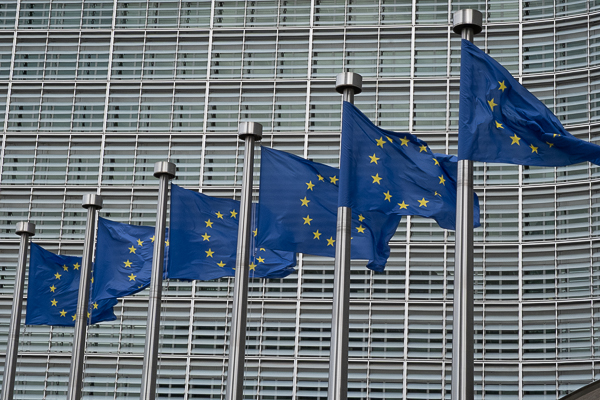
 EU flags in front of the Berlaymont building, headquarters of the European Commission, in Brussels, Belgium, July 2025;
Credit: Ali Sahib, Chronicle.lu
EU flags in front of the Berlaymont building, headquarters of the European Commission, in Brussels, Belgium, July 2025;
Credit: Ali Sahib, Chronicle.lu
On Thursday 29 January 2026, the European Commission presented the first European Asylum and Migration Management Strategy and adopted its first EU Visa Strategy.
Asylum & Migration Strategy
The European Asylum and Migration Management Strategy sets out the European Union's political objectives on asylum and migration and will serve as a compass with concrete priorities for the next five years:
- Stepping up migration diplomacy: Promoting comprehensive and mutually beneficial partnerships that ensure an effective and rights-based cooperation on migration; using incentives and levers across sectors and policy areas; Implementing a whole-of-route approach that helps partners build resilient and humane migration and asylum frameworks; further stepping up the global fight against migrant smuggling to prevent dangerous journeys; promoting pathways to protection and supporting returns from third countries, to help reduce pressure on partners and shield them from the abuses of smugglers.
- Strong EU borders to enhance control and security: Deliver the world's most advanced digital border management system, with the roll-out of the Entry/Exit System (EES) and the launch of the new European Travel Information Authorisation System (ETIAS); screen all illegal arrivals to the EU and apply border procedures at our external borders under the Pact on Migration and Asylum; further strengthen the role of Frontex with a revision of its founding regulation.
- A firm, fair and adaptable asylum and migration system: Assisting national authorities in implementing the new rules with dedicated Commission country teams and additional €3 billion of funding to set up efficient procedures and better prevent unauthorised secondary movements; following the adoption of the first Solidarity Pool, ensuring continued solidarity for Member States under pressure; further strengthening and complementing the Pact to adapt to new challenges.
- More effective return and readmission: Building a common European system for return, based on the proposed Return Regulation, currently under negotiation, with more efficient rules, digitalised processes, and new innovative aspects; improving readmission by third countries, by using and reinforcing the EU's toolbox to promote cooperation.
- Labour and talent mobility to boost competitiveness: Scale up existing and launch new Talent Partnerships and fully integrate talent acquisition into the EU's comprehensive cooperation with partner countries; simplify and accelerate the rules and the process to attract the skills Europe needs; fight illegal employment and exploitation of migrant workers and improve integration in host Member States, supported by EU funding.
According to the European Commission, the strategy also promotes the full use of the potential of digitalisation and artificial intelligence (AI) in asylum and migration management, setting up a Forum on AI and Migration this year.
To support the implementation of this strategy, the European Union will make strategic use of EU funding as set out in the Commission's proposals for the next Multiannual Financial Framework (MFF) 2028-2034. This includes a proposal to dedicate an overall amount of at least €81 billion to home affairs policies and a Global Europe instrument, designed to match a more strategic approach to international partnerships, in alignment with the EU's strategic interests, including on migration. EU Agencies will provide reinforced operational support to Member States.
Visa Policy Strategy
The European Commission is also adopting its first-ever EU Visa Strategy. This sets out a framework for a more strategic visa policy that promotes the EU's long-term interests and enables it to better address growing mobility and the consequences of regional instability and geopolitical competition.
This strategy aims to make Europe:
- safer, by strengthening the first line of security checks;
- more prosperous and competitive, by facilitating access for people who contribute to the EU's economies and societies;
- more influential globally, by advancing the EU's strategic interests, values and international role;
- more effective, through a smarter, more modern and more coherent visa policy.
Alongside the Visa Strategy, the Commission is adopting a recommendation on attracting talent for innovation, to make the EU more attractive to highly qualified and skilled professionals, students, researchers and innovative entrepreneurs and to support the EU's competitiveness in a global context.
The Visa Strategy is built on three key pillars:
- Strengthening the EU's security: The strategy puts forward concrete measures to leverage visa policy to advance the EU's strategic interest and strengthen the EU's security framework.
- Boosting prosperity and competitiveness: The strategy puts forward new measures to support the EU's global competitiveness, attract and retain talent, and make legitimate travel easier, faster and more predictable for tourists and business travellers.
- Modern visa tools: The EU is deploying advanced digital tools to modernise visa and border management. The EU's IT systems will be interoperable by 2028, making it possible to query multiple databases at once and through a single, central search, improving information-sharing and preventing visa abuse.
Recommendation
The Commission's recommendation on attracting talent for innovation sets out concrete ways in which Member States can better use their processes to attract and retain students, researchers and highly qualified and skilled workers, startup founders and innovative entrepreneurs in key sectors for the EU's competitiveness and strategic autonomy.
The recommendations encourage Member States to have simpler and faster procedures for long-stay visa and residence permits through more digitised processes, fewer documents and shorter processing times, easier transitions to work or entrepreneurship from study or research in the EU, improved intra-EU mobility as well as better access to information and stronger coordination between Member States' authorities, universities and research organisations.
According to the Commission, the recommendation contributes to the objectives of the Choose Europe initiative focusing on attracting and retaining global research and innovation talent, the Union of Skills, as well as the EU Startup and Scaleup strategy.