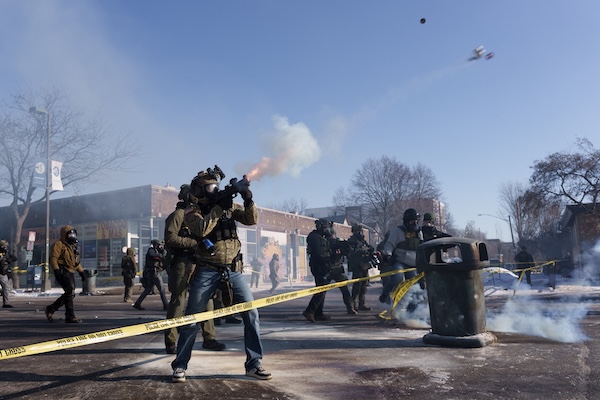
 A federal agent fires a munition toward demonstrators near the site where a man identified as Alex Pretti was fatally shot by federal agents trying to detain him, in Minneapolis, Minnesota, US, Saturday 24 January 2026;
Credit: REUTERS/Tim Evans
A federal agent fires a munition toward demonstrators near the site where a man identified as Alex Pretti was fatally shot by federal agents trying to detain him, in Minneapolis, Minnesota, US, Saturday 24 January 2026;
Credit: REUTERS/Tim Evans
WASHINGTON/MINNEAPOLIS (Reuters) - On Tuesday 27 January 2026, President Donald Trump's border czar, Tom Homan, met with the Minneapolis mayor and the Minnesota governor in a show of detente, as the White House sought to ease unrest gripping the city after two US citizens were shot dead by federal agents.
Homan was put in charge of the Minneapolis immigration enforcement drive to replace US Border Patrol "commander at large" Gregory Bovino, who sources said was being demoted and removed after having overseen most of Trump's crackdowns in Democratic-led cities.
The move was part of a broader reset by the Republican president - who faces mounting political pressure - to soften his administration's aggressive deportation tactics.
Some advisers have expressed concern that national outrage over the killing of 37-year-old Alex Pretti on Saturday 24 January, and the administration's immediate defence of the agents who shot him, could derail Trump's broader immigration agenda.
As they did after this month's fatal shooting of 37-year-old Renee Good, some administration officials initially responded to Pretti's killing by accusing him of "domestic terrorism," a claim belied by witness video verified by Reuters that showed he posed no threat.
Homan's job in Minneapolis is to "recalibrate tactics" and improve cooperation with state and local officials, a source with ties to the White House said, adding, "The goal is to scale back, eventually pull out."
Speaking of the Minnesota situation on Fox News on Tuesday, Trump said his administration was "going to de-escalate a little bit."
"I don't think it's a pullback. It's a little bit of a change," the president said. Asked whether he retained confidence in US Homeland Secretary Kristi Noem, whose role in the crisis brought calls for her dismissal or impeachment from leading Democrats on Capitol Hill, Trump said: "I do."
The president met with Noem, at her request, for two hours in the Oval Office on the evening of Monday 26 January, a source briefed on the matter confirmed.
Recalibrating the surge
A senior Trump administration official said Homan would move away from the broad, public neighbourhood sweeps that Bovino had conducted in Los Angeles, Chicago, Minneapolis and other cities and adopt a more traditional, targeted approach.
In a statement, Minneapolis Mayor Jacob Frey said he had reiterated to Homan his request that the enforcement action, known as Operation Metro Surge, "come to an end as quickly as possible," and that city leaders would remain in touch with Homan. The 30-minute meeting included the city's police chief.
In a separate meeting with Homan, Governor Tim Walz said he had outlined the state's priorities, including impartial investigations into the two shootings and a reduction in the 3,000-strong force of federal agents deployed to the city. Homan and Walz agreed to continue working toward those goals, the governor said.
Homan called the meetings a "productive starting point" for additional "conversations with key stakeholders in the days ahead."
Tension in Minneapolis stayed high, despite the initial efforts to lower friction.
At a town hall meeting on Tuesday, a man sprayed a foul-smelling liquid at Democratic US Representative Ilhan Omar as she called for ICE to be abolished and for Noem to resign.
Ecuador's foreign ministry said an ICE agent tried to enter its Minneapolis consulate on Tuesday.
Announcing his plan to send in Homan, the subject of a US Justice Department bribery probe that was abruptly closed last year, Trump on Monday sought to cast his designated "border czar" as a neutral figure in the Minnesota crisis who "knows and likes many of the people there."
In weekend talks between the president and his advisers, discussions included reducing the number of agents in Minnesota, focusing the mission more narrowly on deportations, and exploring greater coordination with state authorities, according to a White House official.
Support for Trump's immigration drive wanes
The killing of Pretti, a veterans hospital intensive care nurse shot multiple times by Border Patrol agents during daytime protests, has turned into a full-blown political crisis for Trump, with even some Republicans in Congress calling for investigations.
Coupled with the 7 January shooting of Good, a mother of three, by an Immigration and Customs Enforcement officer, Pretti's death sparked renewed anger over the heavily armed federal agents on the Minneapolis streets.
Late on Monday, Minnesota's chief federal judge threatened to hold the acting head of ICE, Todd Lyons, in contempt for his agency's failures to comply with court orders that some detainees receive bond hearings.
Public support for Trump's immigration enforcement tactics appeared to be waning both before and after the Pretti shooting, a Reuters/Ipsos poll showed. The issue has put Republicans on the defensive ahead of November's midterm elections, when the party's narrow congressional majorities are at stake.
Trump in damage control mode
The typically combative Trump characterised private conversations with both Walz and Frey on Monday as productive, while the two Democratic leaders offered similarly positive comments, a far cry from the vitriol the sides had previously exchanged. Walz and Frey were among several Democratic state and local officials subpoenaed one week ago in a Justice Department probe into whether their opposition to Operation Metro Surge amounted to a crime.
At the White House on Tuesday, Trump expressed sympathy for Pretti's family and said he would be "watching over" the investigation into his killing.
Pretti "certainly shouldn't have been carrying a gun," Trump told reporters in Iowa later on Tuesday, comments that put him at odds with gun rights groups and some Republicans.
While Trump stood by Noem, the three top Democrats in the US House of Representatives and the ranking Democrat on the House Judiciary Committee said they would seek to initiate impeachment proceedings against her unless she was fired.
Any impeachment would require some level of support from Republicans, who control the House, to move forward.