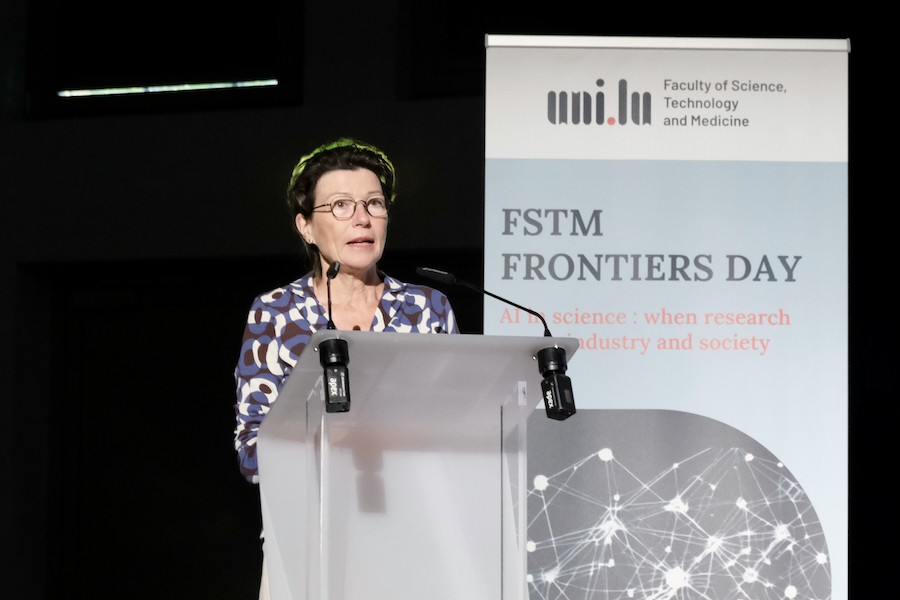
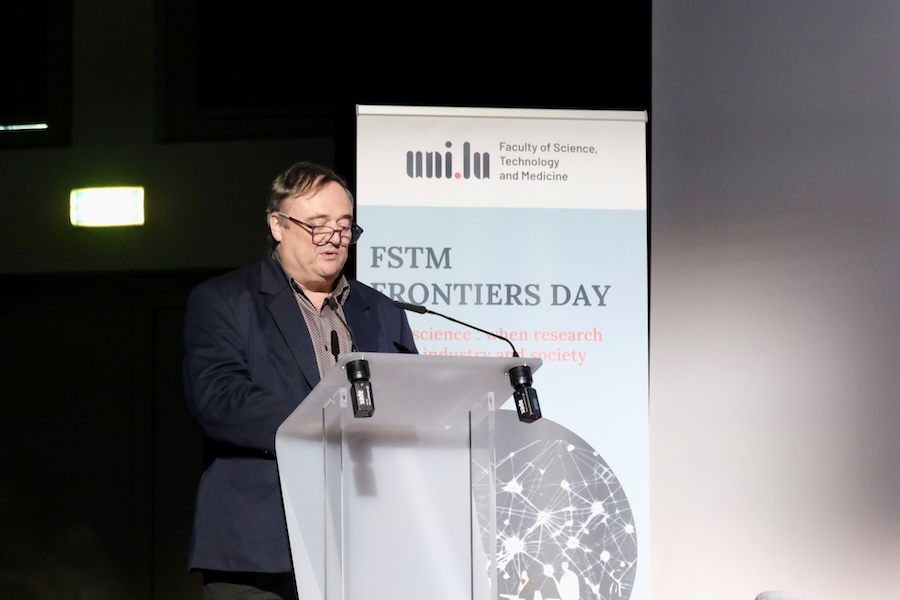
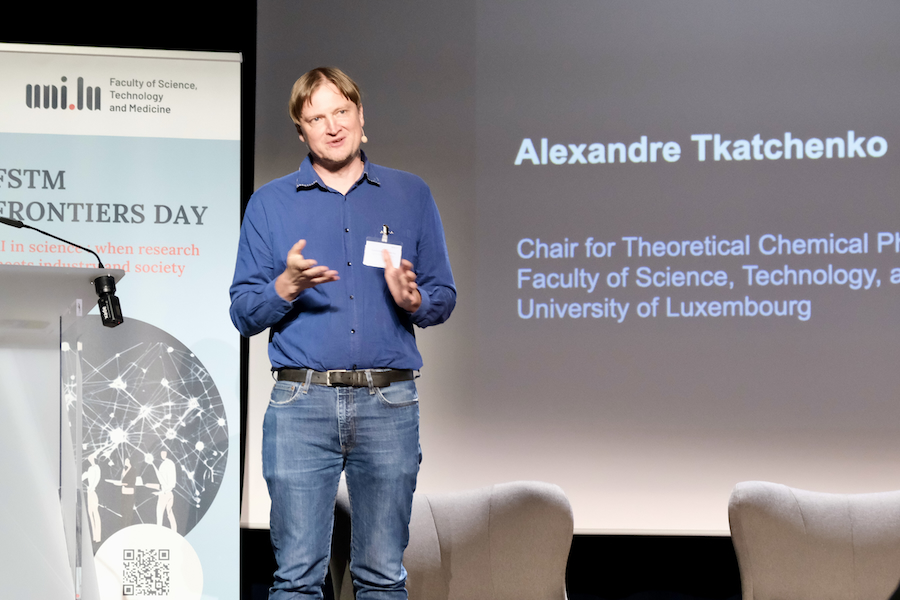
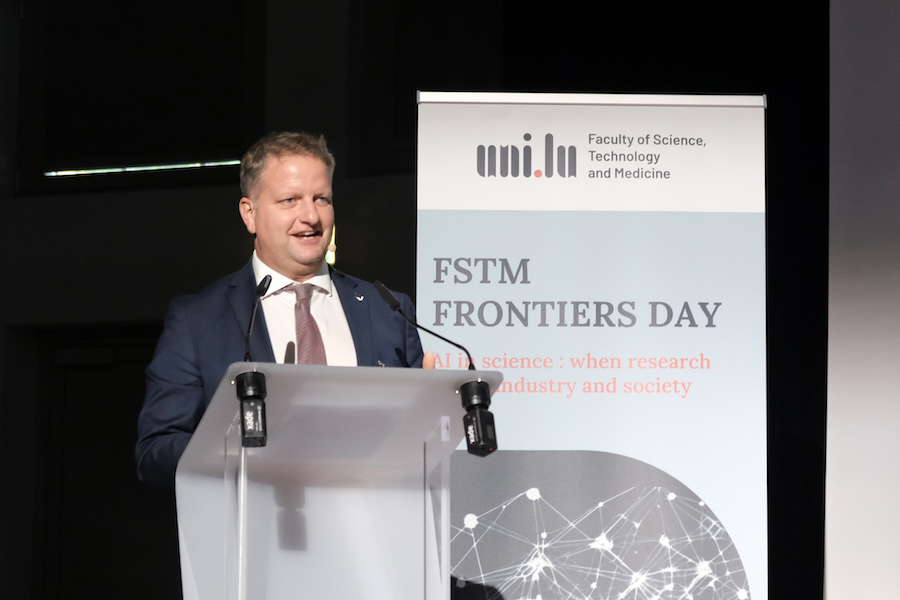
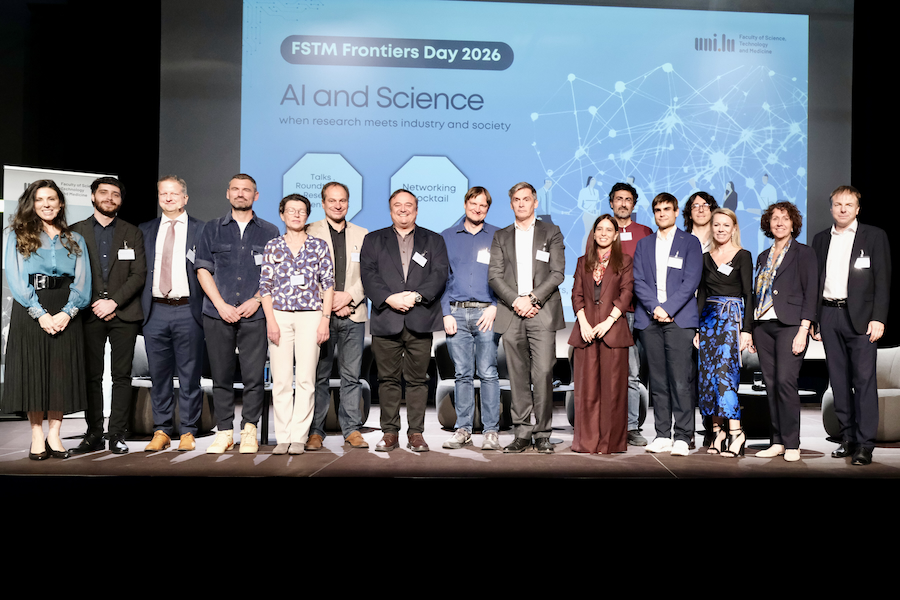
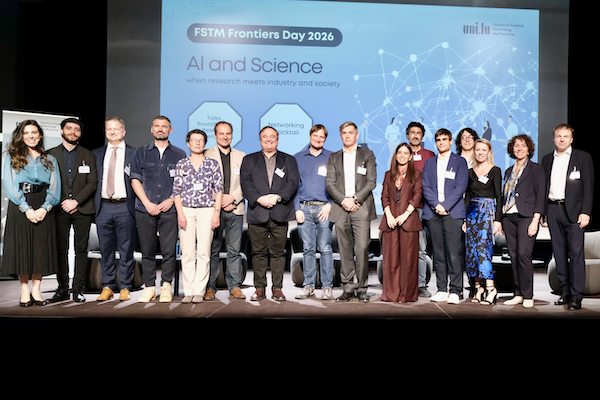
 University of Luxembourg’s FSTM Frontiers Day on the subject of “AI and Science: when research meets industry and society”;
Credit: Steven Miller, Chronicle.lu
University of Luxembourg’s FSTM Frontiers Day on the subject of “AI and Science: when research meets industry and society”;
Credit: Steven Miller, Chronicle.lu
On Monday 5 October 2026, the University of Luxembourg hosted the first Frontiers Day of the Faculty of Science, Technology and Medicine (FSTM) at Tramsschapp in Luxembourg-Limpertsberg.
The event brought together students, researchers and industry representatives to foster collaboration, showcase innovation and engage stakeholders, under the theme of “AI and Science: when research meets industry and society”.
The event welcomed around 300 attendees and was opened with speeches from Vice-rector for Research, University of Luxembourg, Simone Niclou and Dean of the Faculty of Science, Technology and Medicine, University of Luxembourg, Pascal Bouvry.
Simone Niclou noted that the FSTM faculty is the university’s largest, with the highest number of study programmes and the highest number of diverse research activities, including internationally recognised research in the domains of mathematics, physics and material sciences, engineering, computer sciences, life sciences and medicine.
On the growing influence of AI in Luxembourg she said: “The university is a driving force behind the Luxembourg AI Factory, which is the one-stop shop for companies who want to test and use AI solutions within Luxembourg. We are also a driving force behind high-performance computing in the country, working hand-in-hand with LuxProvide to deliver high-performance computing capacity and technological and scientific expertise to the community.”
“Today we bring together our academic community and external partners to explore emerging ideas, share scientific achievements and foster new collaborations across disciplines. This event reflects our commitment to advancing knowledge, pushing boundaries and developing solutions that contribute effectively and positively to society.”
In his speech, Pascal Bouvry detailed how the FSTM collaborates with different industries, as well as its work in the areas of data science, cyber security, and quantum technologies, and remarked: “We are committed to educating and empowering future generations and innovators… We also perform cutting-edge research and provide a way also to disseminate this research to organisations, companies, partnerships and so on. Today the idea was to bring us along to learn… how artificial intelligence and science are evolving together.”
He added: “We believe in the technique of data research with real-world applications, and AI driven design, can translate into tangible, positive impact for society and the economy.”
The event’s first keynote speech was delivered by Professor in Theoretical Condensed Matter Physics, University of Luxembourg, Alexander Tkatchenko, on the subject of “AI for molecular simulations: the evolving role of universities, startups, and industry”.
Professor Tkatchenko talked of the use of quantum mechanics in areas such as molecular simulations and how this has been applied to the discovery and creation of pharmaceutical products, including resolving issues with known medicines. He noted the progress in the use of AI to further research in this field and how it has helped speed the process of innovation in certain areas to new heights but also spoke on the issue of how Europe lags behind its competitors in scaling AI developments and bringing them to market.
He said: “Europe clearly has the science and has the people but it needs to change the attitude. It needs to be more agile… We need to create investment environments and culture.”
There then followed a presentation spotlighting faculty research into the use of Artificial Intelligence (AI) as a scientific driver, which featured six presentations on the subjects of Digital and Data Innovation, Health and Biomedicine, and Sustainable Science and Engineering:
⁃ AI for capacity assessment and planning by Professor Ivan Nourdin, Department of Mathematics;
⁃ Responsible language processing by Postdoctoral researcher Salima Lamsiyah, Department of Computer Science;
⁃ New strategies for cellular reprogramming by Postdoctoral researcher Gustavo Magaña Lopez;
⁃ Cancer immunity, decoded and redesigned by Professor Richard Chahwan;
⁃ AI-assisted design of steel structures by Doctoral researcher Adriano Silva de Carvalho; and
⁃ Data-driven methods for bridge maintenance by Professor Numa Bertola.
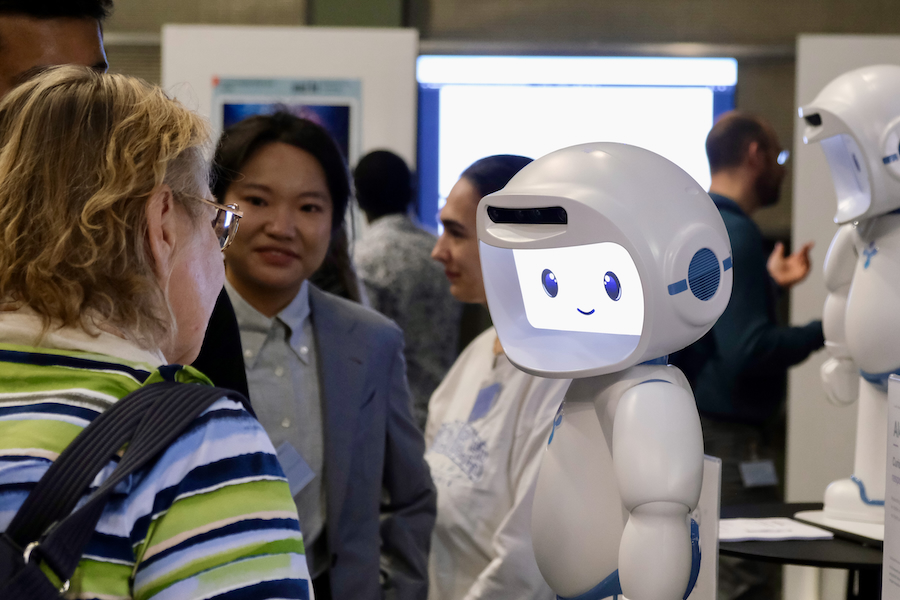
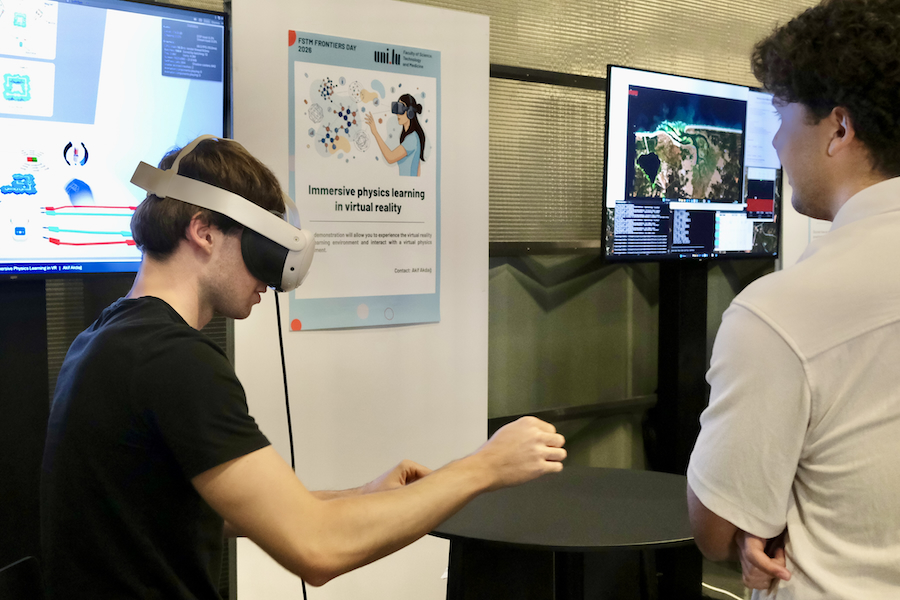
Each presentation detailed a diverse range of uses for AI in science and, during a break in proceedings, attendees invited were to the venue’s foyer to investigate demonstrations of the technology given by the University of Luxembourg’s departments of Computer Science and Mathematics. These included demonstrations on AI-controlled drone swarms, data-driven planning in chemotherapy care and safe, explainable and compliant AI for Kids, among others.
The event’s second keynote speech, “Choose Europe for AI Science”, was given by Deputy Head of AI in Science and Critical Technologies, European Commission, Bertrand De Longueville, who discussed the progress of AI development in Europe and how specialised AI models are now being used in the science domain to solve previously unresolved mathematical models, but stressed that there is a difference between applying AI to science and the science of AI itself.
He noted the introduction of the AI Act and how this can ensure that the AI development is respecting the rights of the users but did remark that regulation can impact innovation and there are areas of AI implementation that will require exceptions.
Bertrand De Longueville asked: “How can we make the science better by getting access to the best models under safe conditions and also get the sales and AI-related resources that can be turned into a more energetic discovery engine? We need to strongly develop that vision in good terms and deal with the regional policy rationale… We need to ensure that this engine is ready and delivers the results.”
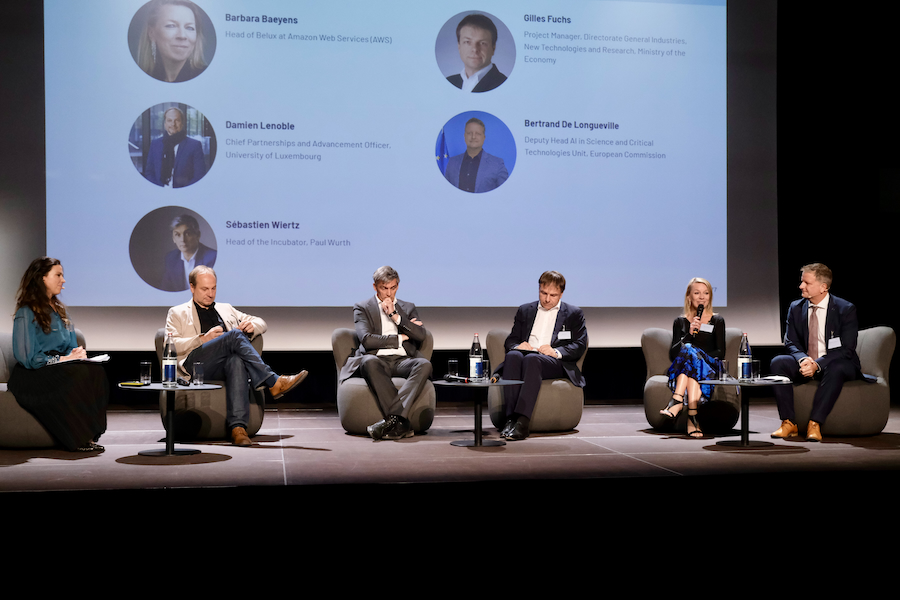
There then followed a roundtable discussion, moderated by Lisa Burke, on the challenges and opportunities of collaborations with AI technology, and featured contributions from Barbara Baeyens, Head of Belux at Amazon Web Services (AWS); Gilles Fuchs, Project Manager, Directorate General Industries, New Technologies and Research, Ministry of the Economy; Damien Lenoble, Chief Partnerships and Advancement Officer, University of Luxembourg; Sébastien Wiertz, Head of Incubator, Paul Wurth and Bertrand De Longueville.
The subjects discussed included developing AI assets for Europe, tutoring and retaining AI talent, and dealing with the scope of technological change in both an educational and functional capacity.
The event then concluded with a networking cocktail.