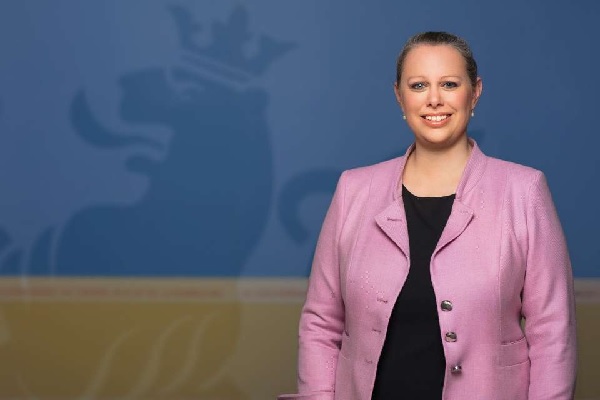
 Carole Dieschbourg, Luxembourg's Minister of the Environment, Climate and Sustainable Development;
Credit: SIP
Carole Dieschbourg, Luxembourg's Minister of the Environment, Climate and Sustainable Development;
Credit: SIP
On Friday 23 April 2021, on the sidelines of the informal meeting of environment ministers, Carole Dieschbourg, Luxembourg's Minister of the Environment, Climate and Sustainable Development, participated in ministerial discussions as part of the “Leaders Climate Summit” in order to support renewing transatlantic links and presenting Luxembourg's progress in climate policy.
On the initiative of US President Joe Biden, the Leaders Climate Summit was held from 22 to 23 April 2021 under the chairmanship of Presidential Special Envoy, John Kerry.
Transatlantic Climate Partnership
During her speech, Carole Dieschbourg, who had co-piloted the European position during the negotiations leading to the Paris agreement, welcomed President Biden's initiative while insisting on the importance of continuing to increase the level of ambition of international climate policy: "I would like to warmly congratulate the United States for choosing, among President Biden's very first administrative acts, to join the Paris Agreement and to set an ambitious goal of reducing emissions greenhouse gases for his country. We need a new dynamic in the fight against the climate crisis at the international level. At the moment, determined national contributions are still grossly insufficient. To move forward, we need a strong signal from the major geopolitical blocs and I am counting very much on the renewal of the transatlantic partnership on climate policy. The "Leaders Climate Summit" in this sense represents an important step in order to be able to achieve a satisfactory result on a global scale, corresponding to the scientific recommendations, at the COP26 in Glasgow in November 2021".
Luxembourg leader in international climate finance
Such a positive outcome at COP26 in Glasgow is unlikely without a real game-changer in international financing for climate adaptation. Luxembourg is currently the largest per capita contributor to international climate finance and, together with Sweden, the largest per capita contributor to the “Green Climate Fund”, one of the world's main financial instruments with over $8 billion invested and 194 countries involved.
However, public investment alone will not be enough to accelerate the momentum of international finance for climate adaptation. This is why Luxembourg has placed the emphasis on mobilising the private sector, taking advantage of innovative financing mechanisms, in its strategy for international climate finance.
Luxembourg climate law
In December 2020, the Chamber of Deputies passed Luxembourg's first climate law, committing the country to limit global warming to 1.5 degrees Celsius compared to the pre-industrial era. To achieve this, the law defines 2 different national ambition levels, namely climate neutrality by 2050 at the latest and the intermediate objective of a 55% reduction in greenhouse gas emissions by 2030 compared to 2005. These objectives will be supported by sectoral sub-objectives for the 5 main emitting sectors. The climate law also provides for a new system of climate governance with an inter-ministerial coordination committee, a new scientific observatory for the climate and a dialogue platform bringing together the various stakeholders of Luxembourg society.
As for the tools that the Luxembourg government is giving itself to achieve its objectives, the Integrated National Energy and Climate Plan (PNEC) also specifies for the next ten years more than 200 flagship measures to reduce greenhouse gas emissions in Luxembourg.