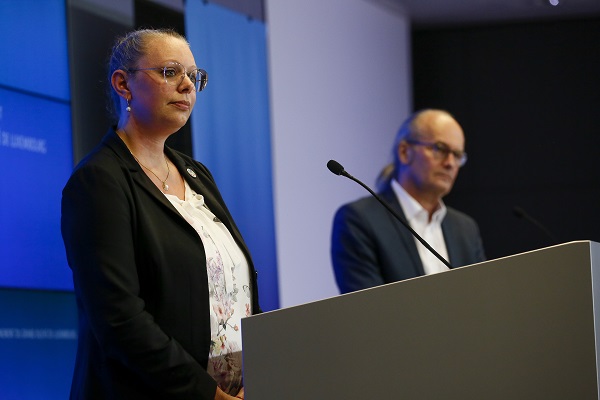
 L-R: Carole Dieschbourg, Luxembourg's Environment Minister; Claude Turmes, Luxembourg's Energy Minister;
Credit: SIP
L-R: Carole Dieschbourg, Luxembourg's Environment Minister; Claude Turmes, Luxembourg's Energy Minister;
Credit: SIP
Luxembourg's government has announced the introduction of a solidarity polluter pays principle and strengthened support measures for the ecological transition.
On Friday 30 October 2020, during a meeting of the parliamentary environment committee, Luxembourg's Minister of the Environment, Climate and Sustainable Development, Carole Dieschbourg, and Minister of Energy, Claude Turmes, gave additional explanations on the main measures of the 2021 state budget which aim to strengthen the efforts undertaken for climate protection.
Like many European countries, Luxembourg has decided to introduce a minimum carbon price from the year 2021. This polluter pays principle is one of the measures provided for in the “Luxembourg Integrated National Energy and Climate Plan”, which aims to achieve the objectives of the Paris Agreement. The government thus intends to reduce greenhouse gas emissions by 55% by 2030 compared to the 2005 reference year.
The minimum carbon price applies to fuels (petrol and diesel), as well as heating oil and gas. By taking into account the climate cost of fossil fuels, it is expected to help accelerate the shift to CO2-free mobility and heating systems powered by renewable energies, which accelerates the ecological transition and improves air quality. The polluter pays principle will thus establish a system where the costs resulting from pollution reduction measures are borne by the polluter.
The starting price will be €20 per tonne of CO2 emitted. For diesel, for example, this represents around 5 cents per litre. The rate will gradually increase over the next few years, reaching €25 per tonne of CO2 emitted in 2022 and €30 per tonne in 2023.
Targeted use of revenues are expected to ensure the solidarity of the carbon price. Income will thus be distributed in a balanced way to finance concrete measures to combat climate change and fiscal and social measures which, in the interests of social equity, will directly target low-income households. For instance, tax credits for employees (crédits d'impôt pour salariés - CIS), pensioners (crédits d'impôt pour pensionnés - CIP) and the self-employed (crédits d'impôt pour indépendants - CII) will increase from €600 to €696 as of 1 January 2021. In addition, the cost of living allowance will be increased by 10% from the same date.
The other part of the revenue will be allocated to measures in favour of the ecological transition.
In addition to the existing aid schemes (Clever wunnen, Clever fueren, Clever lueden, Clever solar) which have been strengthened and proven successful, the government has decided to add additional incentives for energy renovation as well as for the installation of photovoltaic systems. In order to encourage homeowners to carry out a sustainable energy renovation, the minimum age of the building required for the application of the super-reduced VAT rate of 3% has been reduced from 20 to ten years.
Moreover, for owners of housing leased sustainably, a depreciation rate of 6% is granted for ten years for any investment expenditure in energy renovation benefiting from financial aid from the “Clever wunnen” regime which is granted by the Environment Ministry.
Finally, to further support the development of solar energy, the power threshold from which the income from the operation of a photovoltaic installation constitutes taxable income will be increased.