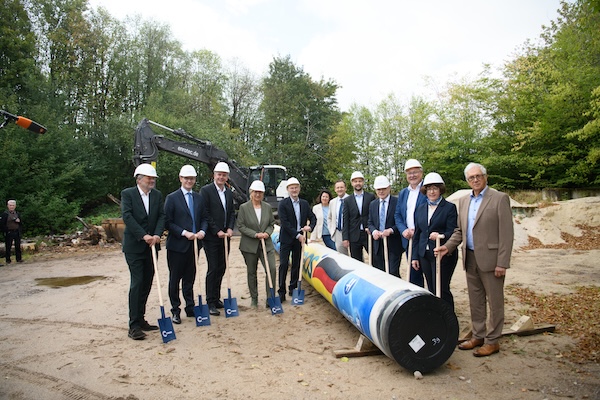
 Group photo;
Credit: Creos Deutschland / J. Weyland
Group photo;
Credit: Creos Deutschland / J. Weyland
On Friday 28 August 2026, Lex Delles, Minister of the Economy, SMEs, Energy and Tourism took part in a ceremony organised by Creos Deutschland GmbH in Wallerfangen (Saarland), marking the official start of construction work on the first hydrogen pipeline of the cross-border mosaHYc (moselle-saar-Hydrogen conversion) project.
According to Luxembourg's Ministry of the Economy, the symbolic groundbreaking marked an important step in the development of the strategic energy infrastructure for the Greater Region and of a hydrogen economy at European level.
The mosaHYc project is based on close cooperation between several partners from the three countries concerned. It aims to create a cross-border corridor enabling the transport of renewable and low-carbon hydrogen between France and Germany, while ultimately strengthening the integration of energy infrastructure in the Greater Region, noted the ministry.
The ministry said that the new pipeline, approximately seventeen kilometres long on the German side, will eventually connect Leidingen with Dillingen and enable hydrogen to be transported from France to the region's main industrial centres. At the same time, existing infrastructure on the French side will be adapted and expanded to create an operational cross-border network.
Reportedly, the ceremony was attended by, among others: Anke Rehlinger, Minister-President of Saarland; Johannes Steiniger, Parliamentary State Secretary to the German Federal Minister for Economic Affairs and Energy; François Werner, Vice-President of the Greater Region; Claude Seywert, CEO of Encevo SA; and Frank Gawantka, Managing Director of Creos Deutschland GmbH.
At the ceremony, Minister Delles said: "This project shows just how essential shared infrastructure and cross-border cooperation are for our energy future. For Luxembourg, mosaHYc represents another important step towards an interconnected European hydrogen infrastructure and lays the foundations for future connections with the networks of our neighbouring countries. More infrastructure dedicated to hydrogen means greater security of supply, competitiveness and resilience for our country and for the Greater Region."