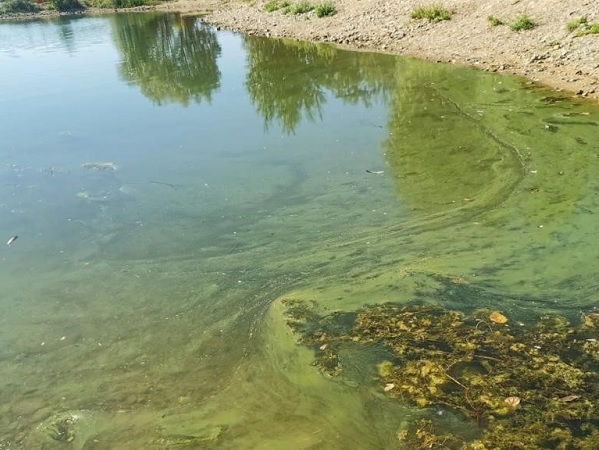
 Blue Algae in lake at Remerschen;
Credit: Erliefnis Baggerweier
Blue Algae in lake at Remerschen;
Credit: Erliefnis Baggerweier
On Tuesday 11 August 2026, Luxembourg’s Water Management Administration issued an alert concerning the presence of cyanobacteria, also known as "blue-green algae", at Burfelt and Rommwiss beaches at the Upper Sûre Lake.
The administration reported that, as part of the regular monitoring of bathing water quality, a proliferation of cyanobacteria has been detected at the two beaches, with analyses carried out on Monday 10 August 2026 revealing the dominant presence of Dolichospermum sp. and traces of Microcystis aeruginosa, a toxic cyanobacteria, as well as toxin levels exceeding the action threshold.
Due to the health risks involved, a swimming ban has been imposed with immediate effect for Burfelt and Rommwiss beaches, in accordance with the amended Grand-Ducal regulation of 19 May 2009 establishing special protection measures and monitoring programmes for bathing water quality.
The administration detailed that certain species of cyanobacteria produce toxins which can pose a health risk to humans, aquatic fauna, domestic animals and livestock. The Luxembourg Institute of Science and Technology (LIST) has therefore been tasked with monitoring cyanobacteria in Luxembourg's official bathing areas.
The administration added that health problems linked to contact with, ingestion of or inhalation of these substances vary in nature and severity. They may include, for example:
• headaches;
• skin irritation and/or burning sensations;
• nausea.
Anyone experiencing health problems after swimming is advised to contact their doctor and mention any possible contact with toxic cyanobacteria.
Furthermore, for bodies of water where significant cyanobacterial growth has been detected, the Water Management Administration, based on the assessment of the Health Directorate, recommends that the public:
• do not allow dogs or other domestic animals to drink the water;
• avoid any contact with the water;
• avoid all water-based activities (e.g. water sports, fishing).
In particular, when fishing:
• avoid contact with fish;
• do not consume caught fish;
• stop fishing activities if visible cyanobacterial blooms are present.
Any observation of blue-green algae in Luxembourg can be reported via the Bloomin’Algae app and will be assessed by a LIST expert. All reports can be accessed at cyanowatch.lu.
As of Tuesday 11 August, swimming remains permitted at the other beaches of the Upper Sûre Lake, namely Fuussefeld, Insenborn, Liefrange and Lultzhausen. However, as a precautionary measure, these beaches have been placed in a pre-alert phase due to the risk of cyanobacterial proliferation.
The administration stressed that there is no risk associated with the consumption of drinking water from the Upper Sûre Lake, as raw water is withdrawn at a depth of approximately 25 meters at the Esch-sur-Sûre dam, where cyanobacteria concentrations are very low. The water treatment system in place also effectively removes toxins produced by the blue-green algae.
The warning follows a similar announcement by the Water Management Administration in late July 2026, when cyanobacteria were detected in the upper lake of Weiswampach.