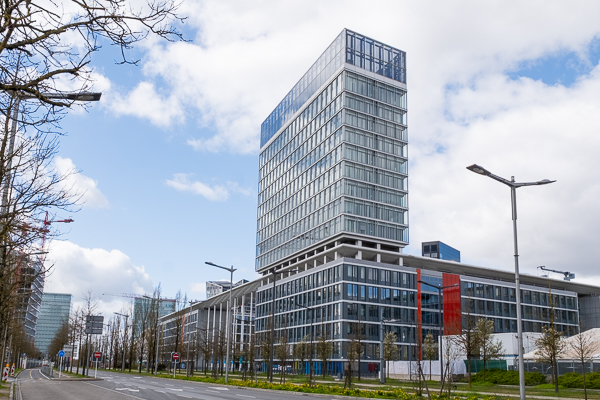
 European Parliament in Luxembourg-Kirchberg;
Credit: Ali Sahib, Chronicle.lu
European Parliament in Luxembourg-Kirchberg;
Credit: Ali Sahib, Chronicle.lu
Chronicle.lu has compiled a new series of articles dedicated to European institutions, bodies and agencies with a presence in Luxembourg.
Standing alongside Brussels in Belgium and Strasbourg in France, Luxembourg City is one of the European Union's three official seats. A founding member of the European Union (EU), Luxembourg is known internationally as a business and financial hub and hosts several major EU institutions and other bodies.
Based mainly in Luxembourg-Kirchberg, these institutions shape European law, finance and democratic processes and employ around 15,000 international professionals.
Throughout this series, Chronicle.lu will introduce the main European institutions, bodies and agencies in Luxembourg and explain how they work. This article focuses on the European Parliament.
The European Parliament (EP) is the EU's only directly elected institution and serves as its main forum for political debate. Citizens across all Member States elect Members of the European Parliament (MEPs) to represent their political interests, shape EU laws and hold other EU institutions to account.
Parliament works alongside the Council of the European Union to adopt and amend legislation and to approve the EU budget, placing it at the centre of European decision-making. It also supervises the European Commission and other EU bodies, questions political leaders, reviews activities and approves key appointments.
The EP held its first session in Strasbourg in 1952, using the chamber of the Council of Europe (CoE). That same year, its administrative secretariat settled in Luxembourg. As the European Communities expanded and Parliament gained stronger legislative powers, regular parliamentary work began to move to Brussels in 1985. Belgium opened the Parliament’s main Brussels complex in 1993, after which most committee and political activity concentrated there.
Member States later formalised this arrangement, confirming Strasbourg as the official seat for plenary sessions, Brussels as the main workplace and Luxembourg as a key administrative centre.
Through plenary sessions in Strasbourg and Brussels, committee meetings and cooperation with national parliaments, MEPs examine legislative proposals, debate amendments and vote on final texts.
The European Parliament currently has 720 seats (2024-2029) - an increase of fifteen compared to the 705 MEPs elected for the 2019-2024 term. None of these seats are based in Luxembourg, as the EP does not host plenary sessions there. At the time of writing, Luxembourg's six MEPs are: Marc Angel (S&D, LSAP); Charles Goerens (Renew, DP); Martine Kemp (EPP, CSV); Tilly Metz (Greens); Isabel Wiseler-Lima (EPP, CSV); and Fernand Kartheiser (non-attached, ADR).
At the EP Secretariat in Luxembourg, around 4,000 staff work in administrative, translation, information technology (IT), finance and logistics services that support the Parliament’s daily operations. The Secretariat coordinates legislative work and organises plenary sessions and other meetings, while also providing technical and expert assistance to parliamentary bodies and MEPs in the exercise of their mandates. The Konrad Adenauer building in Luxembourg-Kirchberg houses the EP Secretariat. Since May 2024, it has also been home to the Europa Experience visitor centre.
Beyond its institutional responsibilities, the European Parliament aims to promote democracy, human rights, freedom of expression and fair elections worldwide through resolutions, election observation missions and international partnerships.
EO/JCA