 Credit: MENEJ
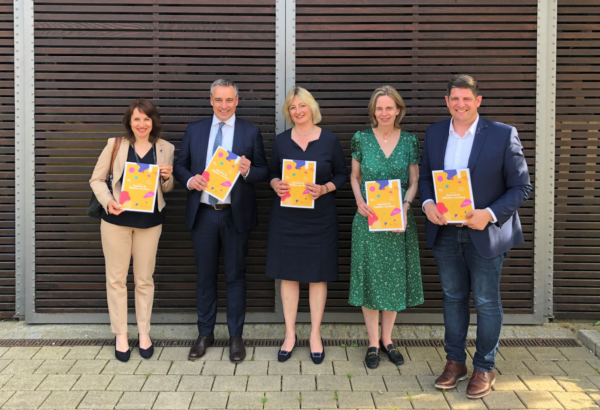
On Wednesday 18 May 2022, as part of National Children's Week, Luxembourg's Minister of National Education, Children and Youth, Claude Meisch, launched the National Action Plan (NAP) 2022-2026 for children's rights at the Walferange eduPôle.
The NAP deals with the priorities that the Committee for the Rights of the Child has set for Luxembourg and is not intended to be exhaustive.
Since the ratification of the Convention on the Rights of the Child 30 years ago, much progress has been made. Yet, as the COVID-19 pandemic and the war in Ukraine show, protecting the rights of children and young people remains a challenge.
Studies such as the 2022 National Report on the situation of children in Luxembourg and the National Report on the situation of youth in Luxembourg indicate that children are extremely resilient and have the ability to adapt. They have qualities on which we can rely. In this sense, the children's rights strategy is a joint commitment for a coherent and transparent implementation of children's rights.
“Children have rights. We adults must inform them and help them to express their opinions and assert their rights. To this end, the government has adopted a strategy for the rights of the child with clear measures and actions, which we should measure ourselves regularly as a society”, underlined Minister Meisch during the presentation.
The rights of the child in practice: so that strong children become strong adults
The rights of the child accompany every day the life of all children, including at school. But anchoring the rights of the child in everyday school life means much more. From the moment when all the children can express their ideas, their wishes, but also their concerns, when different opinions are defended and respected, the rights of the child constitute the basis of any exchange. They are part of the process by which children make their own decisions and learn to deal with the consequences that come with them. And it is these situations that make children strong people and allow them to become responsible individuals in a democratic system.
“Strong kids are kids who have their own opinion, think critically and want to be part of the discussion. This is why it is important to place children at the center of educational policy: children must be able to be children, but they must also become strong adolescents and adults. This is why we must rely on their strengths and help them to live their rights”, further specified Minister Meisch.
The development of the action plan: a broad consultative process
The current action plan presented on 18 May was defined through a broad consultation process with all relevant partners – other ministries, civil society representatives and children – between September 2021 and March 2022. Eight areas have selected: identity and non-discrimination, placement measures, health and well-being, unaccompanied minors, justice for children, violence, rights of children in crisis and the right to participation.
The Plattform "Kannerechter" of the Ministry of National Education, Children and Youth brings together the key actors of children's rights and identifies, monitors and evaluates the measures of the action plan.
The action plan includes 64 distinct actions that have been selected based on the objectives of the child rights strategy with all partners. One of the main objectives is to strengthen the participation of children and young people. Thus, direct consultation with children and young people and all other partners during the implementation of the national strategy for the rights of the child is a priority.
A first assessment of the actions will be drawn up in 2023.