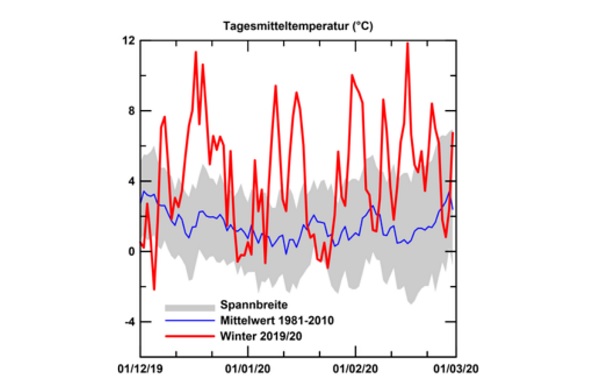
 Average daily temperature for winter 2019-20 in Clemency (red) compared to reference period (blue);
Credit: ASTA
Average daily temperature for winter 2019-20 in Clemency (red) compared to reference period (blue);
Credit: ASTA
The ASTA weather bulletin has revealed that winter 2019-20 was too warm and too wet, with record temperatures and rainfall, storms and soft soils.
The State Meteorological Service of the ASTA (Department of Agricultural Services - Ministry of Agriculture, Viticulture and Rural Development) has carried out its national weather analysis for winter 2019-20, taking into account the period from 1 December 2019 to 29 February 2020.
The analysis looked at the network of 32 automatic weather stations across the Grand Duchy. Once again, this year's weather data was compared with the averages of the reference period 1981-2010 with a special focus on the following four representative stations: Asselborn (north), Clemency (south-west), Remich (Mosel) and Grevenmacher (Mosel).
Winter 2019-20, with a positive anomaly of 2.6°C (ie 2.6 degrees warmer than the reference period), was the third warmest winter recorded in Luxembourg since measurements began in 1838. Across the country, winter rainfall was significantly higher than long-term averages. A new record of winter precipitation was recorded in Koerich and new records of precipitation in February were recorded in Beringen, Fouhren, Grevenmacher, Koerich, Remich and Luxembourg City.
Concerning the consequences of these weather conditions on agriculture, ASTA explained how a wet autumn 2019 and winter 2019-20 have saturated the upper soil layers with water again, thus offering the agricultural crops water reserves for the coming months. However, the high rainfall also caused the soils to soften and reduced their load-bearing capacity, especially on clayey soils. At these locations, the upcoming field work, such as the spreading of organic fertiliser, tillage and sowing, will be difficult in spring. Furthermore, various cultures on the heavy clayey soils have suffered from the persistent waterlogging and are currently in poor agricultural condition.