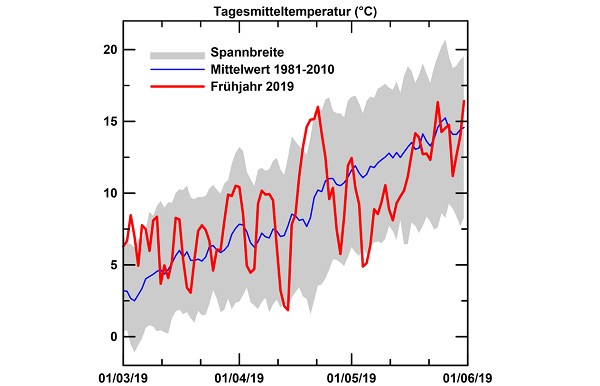
 Credit: ASTA
Spring 2019 in Luxembourg was characterised by above average temperatures in March and April, a cooler May, too little rain in the north and too much rain in the south of the country, according to the ASTA weather bulletin.
The State Meteorological Service of the ASTA (Department of Agricultural Services - Ministry of Agriculture, Viticulture and Rural Development) has carried out a weather analysis for sping 2019, taking into account the period from 1 March to 31 May 2019. The analysis looked at the network of 32 automatic weather stations across the Grand Duchy.
Once again, this year's weather data was compared with the averages of the reference period 1981-2010. A special focus was placed on the following four representative stations: Asselborn (north), Clemency (south-west), Remich (Mosel) and Grevenmacher (Mosel). The mean temperatures for each of these regions were almost identical to the long-term averages.
However, this March was up to +1.7°C too warm and May was up to -2.3°C too cold. Indeed, in the night of 4 to 5 May, temperatures dropped to -2.5°C along the Moselle, which led to significant frost damage to the vines. The Ösling recorded a rain deficit (up to -60mm in Wincrange), while it rained too much in the south (up to +45mm in Remich).
After an exceptionally mild end to February, the spring of 2019 began quite changeable and stormy. Some depressions quickly moved from the Atlantic to Europe. The storm depression "Eberhard" arrived on 10 March with gusts over 90 km/h over Luxembourg. For a long time, the height of Scandinavia "Katharina" dominated in April, lowering the daily mean temperature to below 5°C in the middle of the month before it rose to early summer levels in time for the Easter weekend. The low temperatures on 13 and 14 April led to local damage to the fruit trees. For its part, May started with temperatures well below the levels of the reference period, resulting in significant frost damage to the vines.
The precipitation totals of spring 2019 divided the country into two parts; whilst there was a precipitation deficit in the Ösling, the rest of the country experienced a slight surplus of precipitation compared to the long-term average. For example, in Asselborn from March to May, the rainfall was below that of the reference period. In particular, May's 37mm was just over half the value of the reference period (68mm). In Clemency, however, March showed a clear surplus of 110mm compared to the reference period (73mm). In Remich, too, the measurements were above the reference period values every three months, which measured the highest positive anomaly in Luxembourg in the spring of 2019 (+47mm). Since 1 January 2019, rainfall at almost all stations has been below the long-term average.