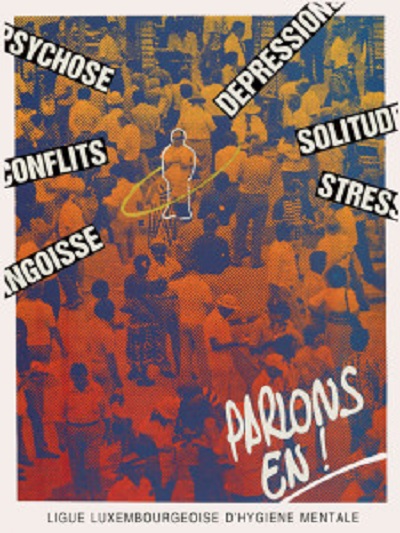
Luxembourg's Minister of Health, Lydia Mutsch, has congratulated the Luxembourg League for Mental Hygiene on reaching its 60th anniversary.
"60 years and a beautiful common history link the Ministry of Health with the Luxembourg League for Mental Hygiene (LLHM), to establish a modern psychiatry!" said Minister Mutsch at an academic evening organised for the 60th anniversary of the LLHM.
In 1956, in the early days of the League, a handful of people had a vision: to go beyond the hospital-centred model in psychiatry and mental health and to move towards a community model for Luxembourg. They wanted to build a community-acquired psychiatric structure in favour of mentally ill patients and to realise its vision of mental health and defense of the mentally ill patient.
The vision has now become reality
The path has not always been easy. Indeed, the past policy of Psychiatry and Mental Health in Luxembourg has undergone numerous reforms. "Yet," said Minister Mutsch, "during all these years the League has always demonstrated an exemplary commitment. For the sake of corporate responsibility and good management, the League was able to take real initiatives in mental health and this for mentally ill and socially vulnerable people."
Honour the past, continue to build the future
The objectives of mental health policy were and still are decentralised psychiatry and avoid chronic institutionalisation of patients, to treat patients with mental disorders in accordance with the achievements of science and avoid or reduce patient stigma, reintegrating them quickly and in good condition in their natural environment.
According to the Minister of Health, the quality of any social policy on mental health is measured above all by the sustained commitment of the State towards its vulnerable and mentally ill people and others. The protection and care of these people are of national solidarity.
"On the occasion of this 60th anniversary, I agree that health policy continues to develop in the area of ??mental health projects and taken into socially equitable burden, economically responsible and ethically acceptable," concluded Minister Mutsch.