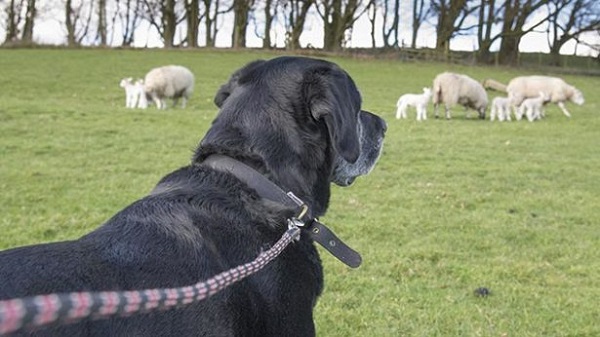
Following the announcement that the Luxembourg Government has adopted a draft amendment to protect the grey wolf, it was revealed on Monday that a sheep killing in September has been determined as the result of a dog attack and not a wild wolf as originally thought.
On 26 September 2015, a sheep was attacked and half eaten near Kayl in south-western Luxembourg. Whilst domestic dogs are often to blame for sheep attacks, they do not usually feed on their prey and recent wolf sightings suggested that the latter could in fact be responsible for the incident. To find out, swabs from the bite wounds were sent to the Senckenberg Institute in Frankfurt/Main in order to be genetically studied.
The results have shown that, despite recent possible wolf sightings in Saarland, the bites were in fact received from a house dog with four sheep attacked in the area. The Senckenberg Institute therefore concluded that the culprits were domesticated dogs rather than wolves or lynxes.
The results indicate that a recent surge in stray dogs in the former mining areas of south Luxembourg may pose a far bigger problem for sheep and goat farmers than wild predators. These domesticated dogs have been known to attack not just sheep and goats but also wild animals such as deer and rabbits, as well as present a serious disruption for endangered ground-nesting birds such as the rare Woodlark, only found in these mining areas.
The Ministry of Sustainable Development and Infrastructure and the Nature Administration therefore appealed to all dog owners, but particularly those with larger breeds, to contain their animals and prevent them from roaming alone and at night. The Ministry reminded the public that in nature reserves such as Dudelange Haard and Gielebotter in Differdange it is prohibited to allow dogs to run free.
Photo by Shutterstock