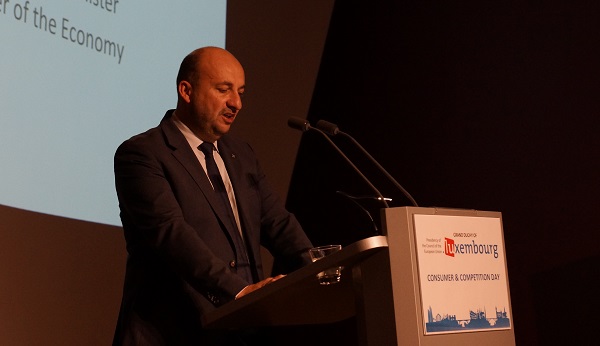
On 21 September 2015, Luxembourg played host to the Consumer and Competition Day organised by the Luxembourg Presidency of the Council of the European Union, which brought together representatives from the Commission, the European Parliament, competition authorities and Member State authorities, business representatives and consumer associations.
The conference was established to focus on strategic priorities for a digital market, put forward by the European Commission on 6 May 2015, with geoblocking and improvements to the access to digital goods and services for consumers and businesses forming the centre of discussions and the first roundtable.
Luxembourg Deputy Prime Minister, Minister of the Economy, Étienne Schneider, stated that the current digital market was "below its capacity", calling for the creation of a real "European market place" through the elimination of barriers and restrictions in the internal markets with a view to putting an end to the "European patchwork of national markets which hurts small and medium enterprises (SMEs) and consumers".
According to the Economy Ministers, only 15% of consumers make online purchases in EU countries other tahn their country of residency, with only 7% of SMEs selling abroad. Furthermore, the disparity between the reality on the ground boosted by supply and demand, and the regulatory framework which struggles to adapt to these changes was reported to be growing.
"There needs to be a reduction if not an elimination of the risks that we run in terms of competitiveness and new sources of jobs that go unexploited," the Minister emphasised, before calling for the creation of a single digital market which would provide for the generation of €250 billion of additional European growth, according to the Commission.
President of the Luxembourg Competition Council, Pierre Rauchs, claimed that despite the extensive progress made since the 1992 introduction of a single market, barriers still exist, particularly with regards to electronic commerce and within small countries such as Luxembourg.
"We want to become more aware of the extent of these barriers and the impact they are having," concluded Johannes Laitenberger, Director General at the European Commission DG COMP.
Photo by Ministry of the Economy (Étienne Schneider)