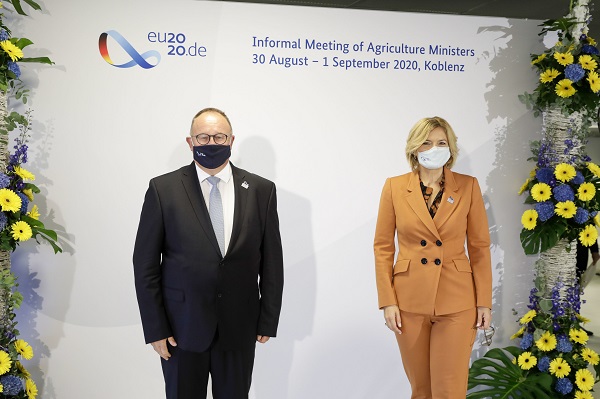
 L-R: Luxembourg's Agriculture Minister Romain Schneider; Germany's Agriculture Minister Julia Klöckner;
Credit: BMEL/photothek
L-R: Luxembourg's Agriculture Minister Romain Schneider; Germany's Agriculture Minister Julia Klöckner;
Credit: BMEL/photothek
Luxembourg's Minister of Agriculture, Viticulture and Rural Development, Romain Schneider, participated yesterday in the informal meeting of EU agriculture ministers in Koblenz, Germany.
During this meeting, the agriculture ministers drew an in-depth assessment of the situation of European agriculture and the lessons learned from the ongoing COVID-19 crisis in relation to the resilience of the agro-food industry to the maintenance of agricultural supply chains and appreciation of European agricultural production.
On behalf of Luxembourg, Minister Romain Schneider reiterated his gratitude to the farmers and all the actors of the agro-food chain, who ensured the production of foodstuffs despite the constraints of the pandemic. With the crisis having highlighted the dependence of certain agricultural sectors on third markets, both in terms of imports and exports, Minister Schneider stressed that the production systems will have to be readjusted in order to reduce these imbalances and support research and innovation. In this context, promoting the production of protein plants in Europe could prove to be an interesting avenue.
The pandemic has also led to consumers' enthusiasm for regional and seasonal products. According to Minister Romain Schneider, “supporting short supply chains is part of the solution and the notion of self-sufficiency must be interpreted at community level. In Luxembourg, the current stimulus plan for agriculture provides for a substantial budgetary envelope for the diversification and promotion of short circuits and quality local agricultural products!”
Luxembourg's Agriculture Minister added that promoting agriculture also means paying more attention to the regions and the origin of foodstuffs, as well as to the protection of the environment, climate and animals. In this context, he welcomed the idea of voluntary labelling providing information on the origin of foodstuffs, as well as on the quality, durability and nutritional value of ingredients. He suggested nonetheless rationalising the various labelling systems. In Luxembourg, the minister will soon present a bill aiming to create an official approval system for Luxembourg labels.
Improving animal protection, which is at the heart of the EU's Farm to Fork strategy and the European Green Deal, was another priority topic in Koblenz. The ministers discussed the introduction of an animal welfare label at the European level, the improvement of conditions for the transport of livestock, as well as the strengthening of the rules concerning the transport of animals to third countries.
Minister Romain Schneider also expressed support for the initiative of harmonised European labelling of animal welfare, commenting: “Animal welfare labelling must be transparent and precise! By informing consumers about the conditions of raising and transporting livestock, they will be able to buy their products knowingly”. As for animal welfare during transport, the minister recalled that to do better, it will be necessary to quickly revise the community regulations in force and to remedy the inaccuracies in the text. He proposed an extension of the regulations to include more animal species and to limit the maximum transport time of animals intended for slaughter to eight hours.