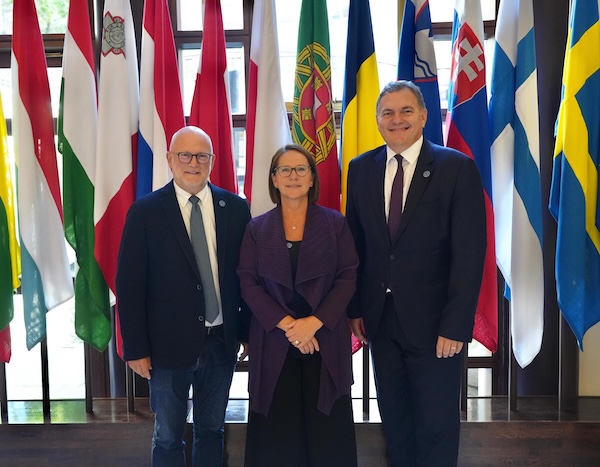
 (L-R) Jean-Luc Crucke, Belgium’s Federal Minister for Mobility, Climate and Environmental Transition; Yuriko Backes, Luxembourg’s Minister for Mobility and Public Works; Philippe Tabarot, France’s Minister for Transport;
Credit: MMTP
(L-R) Jean-Luc Crucke, Belgium’s Federal Minister for Mobility, Climate and Environmental Transition; Yuriko Backes, Luxembourg’s Minister for Mobility and Public Works; Philippe Tabarot, France’s Minister for Transport;
Credit: MMTP
On Tuesday 22 September 2026, Luxembourg’s Ministry of Mobility and Public Works reported on an informal meeting of transport ministers held in Dublin on Sunday 20 and Monday 21 September at the invitation of Ireland, which currently holds the rotating presidency of the Council of the European Union (EU), and attended by Luxembourg’s Minister for Mobility and Public Works, Yuriko Backes.
According to the ministry, the EU ministers, joined by their Swiss, Norwegian and Northern Irish counterparts, addressed two issues: connected and automated driving, and the decarbonisation of transport.
During the first session, discussions focused on the potential of technological developments, such as connected and automated driving, to improve road safety. The ministry noted that the ministers largely shared positive views on the new technologies but stressed the importance of cross-border coordination within the EU.
“Automated and connected vehicles can contribute to improving road safety. For this to succeed, we must not rely solely on autonomous vehicles, but must continue to pursue a coordinated, comprehensive and harmonised approach to integrating these vehicles into a traffic and road safety ecosystem, including the cross-border dimension,” said Minister Backes.
The second discussion concerned recent challenges affecting energy markets, their implications for European transport policy and measures to make the EU more resilient. According to the ministry, the debate indicated that the problem concerned the availability and, above all, the prices of fossil fuels, rather than energy in general.
Minister Backes stressed “that efforts towards the decarbonisation of road transport must continue. Electrification will play a central role. Regarding the behavioural changes required, the priority should be to improve public transport services, rail connectivity and multimodal solutions. Luxembourg has achieved convincing results through the continued development of its free public transport network, combining trams, trains and buses. Active mobility must also play an important role in the modal shift.”
During the visit, Minister Backes met her new German federal counterpart, Steffen Bilger. Their discussions focused mainly on cross-border connectivity, particularly rail links between Luxembourg and Germany. The two ministers also addressed military mobility and airport security.
The Minister also discussed the progress of infrastructure projects related to cross-border mobility and the promotion of carpooling between France and Luxembourg with French Transport Minister Philippe Tabarot.
In a bilateral meeting with Dutch Transport Minister Vincent Karremans, she discussed possible cooperation on drone strategy and autonomous mobility.
The ministry added that Minister Backes discussed the introduction of a road vignette system for passenger cars in Belgium with the German, French and Dutch ministers to strengthen coordination on the subject.