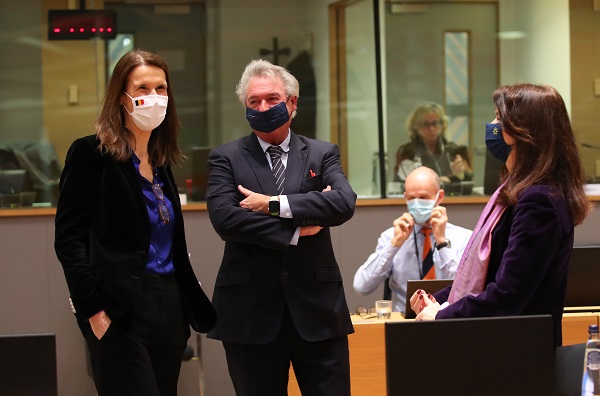
 L-R: Sophie Wilmès, Belgium's Deputy PM, Minister of Foreign and European Affairs; Jean Asselborn, Luxembourg's Minister of Foreign and European Affairs; Ann Linde, Sweden's Minister of Foreign Affairs;
Credit: European Union
L-R: Sophie Wilmès, Belgium's Deputy PM, Minister of Foreign and European Affairs; Jean Asselborn, Luxembourg's Minister of Foreign and European Affairs; Ann Linde, Sweden's Minister of Foreign Affairs;
Credit: European Union
On Monday 22 March 2021, Luxembourg's Minister of Foreign and European Affairs, Jean Asselborn, participated in the Foreign Affairs Council (FAC) of the Council of the European Union (EU) in Brussels.
The FAC began its session with current issues, which enabled the European Foreign Ministers to review the latest international developments. In particular, the ministers discussed EU-Russia relations ahead of the strategic debate scheduled for the European Council on 25 and 26 March 2021. The ministers also discussed the situation in Georgia as well as the latest developments in Venezuela, the Western Balkans, Myanmar and Ethiopia.
Luxembourg's Foreign Minister began by expressing his solidarity with Belgium and paying tribute to the memory of the victims of the terrorist attacks that struck Brussels five years ago, on 22 March 2016.
Regarding Myanmar, where the situation continues to deteriorate following the military coup of 1 February 2021, Minister Jean Asselborn highlighted the importance of the EU working together with the Association of Southeast Asian Nations (ASEAN) in order to achieve a peaceful solution. He also briefed his European counterparts on his recent discussions with the foreign ministers of China, Thailand and Indonesia on the Myanmar crisis.
Minister Jean Asselborn also joined his colleagues in calling for support for Armenia to guarantee the exchange of prisoners of war provided for by the ceasefire agreement in Nagorno-Karabakh, concluded last November.
Subsequently, European Foreign Ministers had an informal exchange of views, via video conference, with the United Nations (UN) High Commissioner for Human Rights, Michelle Bachelet. This exchange made it possible to take stock of the session of the UN Human Rights Council which is underway in Geneva and to discuss the means of supporting the work of this UN organ responsible for strengthening the promotion and protection of human rights in the world.
After recalling that human rights are universal, Minister Jean Asselborn encouraged the High Commissioner to pay a visit to Xinjiang and to continue her efforts to promote the rights of Palestinians. Minister Jean Asselborn also reaffirmed Luxembourg's support for the work carried out by the Office of the United Nations High Commissioner for Human Rights. Luxembourg's desire to strengthen its contribution to the promotion of human rights is reflected in its candidacy to be elected for the first time as a member of the Human Rights Council, for the 2022-2024 term.
In the afternoon, the ministers discussed ways to strengthen dialogue and cooperation between the EU and its Southern Neighbourhood partner countries. In a joint declaration presented by Belgian Minister Sophie Wilmès, the Benelux countries underlined that the relationship with the partner countries of the Southern Neighborhood is of strategic importance for the EU. In the framework of cooperation with these partner countries, emphasis should be placed on "continuous dialogue, the establishment of regional and cross-border cooperation programmes, as well as the rule of law, good governance and respect for fundamental human rights, including gender equality”, stressed the ministers of Belgium, the Netherlands and Luxembourg. They called for strengthened cooperation in areas such as the green economy, digitalisation, migration, conflict prevention and resolution, as well as the fight against terrorism.
Finally, an in-depth exchange of views on EU-Turkey relations was on the agenda. Regarding the latest developments in the Eastern Mediterranean, Minister Jean Asselborn advocated a “cautious but positive approach”, given that it will be necessary to assess whether the latest positive developments are sustainable and credible.
As for the EU accession process, Luxembourg's Foreign Minister pleaded for maintaining Turkey's membership prospect, while deploring the developments in Turkey which are clearly going in the wrong direction. He stated: "Turkey has distanced itself from the EU, in particular in the important areas of democracy, fundamental rights and principles, the rule of law, but also foreign policy". He went on to mention the recent decision of the Turkish President to withdraw his country from the Council of Europe Convention on Preventing and Combating Violence Against Women and Domestic Violence, signed on 11 May 2011 in Istanbul.