 Credit: LBR
Luxembourg's statistical institute, STATEC, has reported that entrepreneurial activities slowed down across Europe, including Luxembourg, in 2020; however, there has been a 20% rebound in new business creation so far this year.
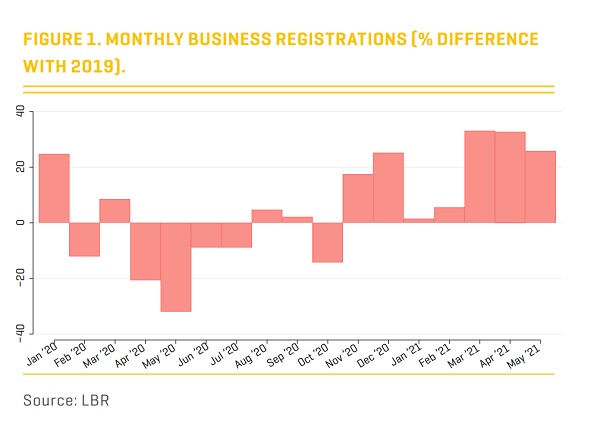
Citing the Global Entrepreneurship Monitor (GEM) report, STATEC confirmed that Luxembourg suffered a decline in entrepreneurial activity comparable to other European countries last year. On the other hand, recent data from the Luxembourg Business Register (LBR) indicated that there was reason for optimism, given a 20% rebound in new business creation in the first five months of 2021.
The sudden economic contraction during the first half of 2020 led to a decline in the share of individuals’ perceiving good opportunities to start a business. In Europe, this share dropped from 51% in 2019 to 40% in 2020. In Luxembourg, this decline was somewhat more pronounced, going from 58% in 2019 to 42% in 2020. As a result, the share of individuals trying to set up a business in the Grand Duchy decreased from 15% in 2019 to about 9% in 2020. This decline was more significant that the European average, which fell from 11% in 2019 to 9% in 2020.
A majority of individuals who decided to start a business stated that the pandemic had delayed getting their businesses operational (68% in Luxembourg, compared to 61% in Europe). The decline in the share of individuals trying to set up a business contributed to a reduction in total early-stage entrepreneurial activity (TEA), i.e. the share of individuals effectively involved in starting or running a new business. In Luxembourg, the drop in TEA (from 10.2% in 2019 to 8% in 2020) was somewhat larger than the European average (from 9% in 2019 to 8% in 2020). However, historical Luxembourg GEM data and the unprecedented challenges brought about by the pandemic provided a more nuanced outlook for TEA; over the period 2013- 2020, TEA remained stable around an average 9.2%, ranging from 7.1% in 2014 to 10.7% in 2018.
By combining the characterisation of the initial effects of the pandemic on entrepreneurship offered by GEM surveys with data from the LBR to account for more recent developments, STATEC could confirm the decline in business registrations during the first half of 2020. However, there was a surge in new business formation over the last months of 2020. This is in line with neighbouring countries like Belgium and France, but in stark contrast with others (e.g. Italy and Spain) that suffered more severe contractions in business entry. Luxembourg’s positive trend continued in the first five months of 2021, during which time new business formation increased by more than 20% in comparison with the same period in 2019.
In 2020, necessity-driven entrepreneurship (i.e. individuals “forced” to start a business out of lack of employment) increased in most European countries, whereas opportunity-driven entrepreneurship (i.e. individuals starting a business to exploit an opportunity) experienced a small decline. These dynamics are similar to those observed for Luxembourg. Notwithstanding these changes, Luxembourg still featured a very high share of opportunity-driven entrepreneurship (50% against an average of 38%), and one of the lowest shares of necessity-driven entrepreneurship (42% against an average of 60%).
The pandemic substantially increased uncertainty, which represents a threat for entrepreneurship. As a result, many early-stage entrepreneurs lowered their growth expectations compared with the past (43% in Europe and 45% in Luxembourg). At the same time, consistently with the idea that crises can lead to the emergence of successful entrepreneurs, a non-negligible amount of early-stage entrepreneurs perceived that the pandemic had brought about new opportunities (32% in Europe and 31% in Luxembourg).
The overall share of individuals discontinuing a business was stable in Europe, including Luxembourg. Among those who declared to have discontinued a business in Luxembourg, the pandemic did not appear as a central determinant of business closures. This figure was only 12% in Luxembourg, compared to the European average of 23%.
In addition, around 76% of early-stage entrepreneurs in Luxembourg agreed that the government response during the crisis was satisfactory, compared to a European average of 46%.