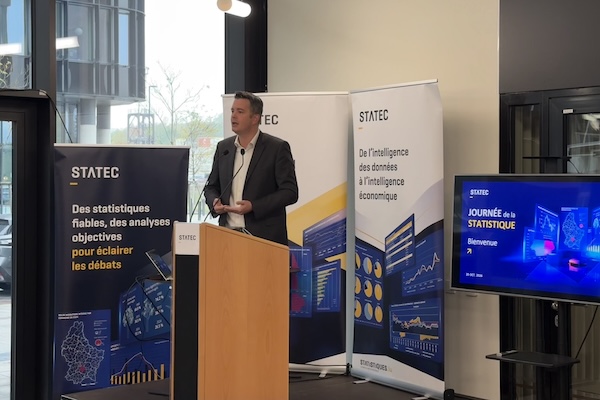
 Lex Delles, Luxembourg's Minister of the Economy, SMEs, Energy and Tourism;
Credit: Ievgenii Karanov, Chronicle.lu
On Tuesday 20 October 2026, Luxembourg's national statistics agency STATEC held its Journée de la Statistique 2026 (Statistics Day 2026) event at its premises in Esch-Belval.
The event brought together around 100 guests, including Lex Delles, Luxembourg's Minister of the Economy, SMEs, Energy and Tourism, and Tom Haas, Director of STATEC.
In his welcome address, Tom Haas highlighted the importance of cooperation within Luxembourg's national statistical system and the wider international statistical community. He stressed the importance of independent, reliable and high-quality official statistics for democracy and informed decision-making.
Tom Haas also addressed the growing role of artificial intelligence (AI), highlighting both its opportunities and the challenges it presents for statistical organisations. He emphasised the need to ensure access to reliable statistical information as AI-powered tools increasingly provide answers directly to users, and referred to cooperation with international partners, including Eurostat.
Turning to the modernisation of official statistics, Tom Haas discussed the potential of administrative data, closer cooperation between public institutions and the development of STATEC's Data Lab. He noted that these efforts aim to improve the efficiency of statistical processes and support new methods of data analysis while maintaining the regular production of official statistics.
In his opening address, Lex Delles emphasised the importance of reliable statistics for public debate and political decision-making. He also referred to the need to strengthen STATEC's capabilities and expertise, particularly in addressing challenges such as misinformation on social media.
Urmet Lee, Acting Head of STATEC's Data Lab, also addressed the challenges facing official statistics amid technological change and the increasing use of different data sources. He raised the question of the future role of national statistical institutes and emphasised the importance of collaboration and shared responsibility in protecting the role of official statistics in democratic societies.
The event also featured a presentation of the winning project from STATEC Hackathon 2026. Martin Kracheel, an official at SCRIPT's Curriculum Development Division, presented the Luxembourg Trade Resilience Radar, an interactive tool designed to analyse Luxembourg's trade dependencies, including trading partners, product categories, supplier concentration and import trends. His team, Scrapped (Menje-SCRIPT), won first prize.
The afternoon programme featured a session on the modernisation of official statistics and data projects within Luxembourg's National Statistical System, with presentations by Marc Pauly, Chief Data Officer at STATEC, Claude Lamboray, Head of the Innovation Unit at the Data Lab, and Leila Deshayes, Head of the Data Centralisation Unit at the Data Lab. Urmet Lee, Acting Head of STATEC's Data Lab, then delivered a keynote address titled "Emerging Responsibilities for and Beyond Official Statistics in an Evolving Data Ecosystem".