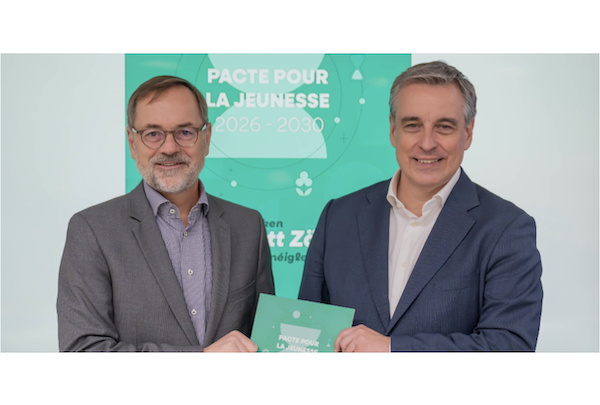
 (L-R) Georges Metz, National Youth Service (SNJ); Director of Claude Meisch, Luxembourg's Minister of Education, Children and Youth;
Credit: MENEJ
On Monday 19 October 2026, Luxembourg's Ministry of Education, Children and Youth presented the fourth Youth Pact (2026-2030), known as the Jugendpakt, which sets out the direction of youth policy for the next five years. Its objective is to enable young people to reclaim their time and devote it to their personal development, engagement and fulfilment.
The new Jugendpakt was presented by the Minister of Education, Children and Youth, Claude Meisch, during a press conference.
The development of the Jugendpakt is anchored in Luxembourg legislation: the amended law of 4 July 2008 provides for the establishment of an action plan for youth policy every five years. The Jugendpakt also takes into account the European Union Youth Strategy (2019-2027) and the Council of Europe Youth Sector Strategy 2030.
According to the ministry, the Jugendpakt 2026 is the result of a broad participatory process involving young people and stakeholders in the youth sector. It draws in particular on discussions held with 250 young people during the minister's tour of four regions of the country in 2025. Following the same approach of direct exchange, the National Youth Service (SNJ) organised six focus groups with more than 40 young people between February and April 2026. These contributions are complemented by the findings of the National Youth Report 2025, as well as dialogue with youth services, youth organisations and representative bodies of the sector (Daachverband vun de Lëtzebuerger Jugendstrukturen, Fédération des acteurs du secteur social au Luxembourg, Jugendrot).
Young people need quality time
According to the ministry, young people today are growing up in a world marked by rapid changes. Technological and social developments, new forms of communication and international crises influence their daily lives and bring new opportunities, but also challenges and uncertainties. The omnipresence of digital technology and social media particularly affects their relationships, leisure activities and identity development. However, the digital environment does not replace face-to-face interactions, which are essential for the development of social skills and the well-being of young people.
In this context, and to promote a better balance between time spent in front of screens and offline activities (Screen-Life-Balance), the ministry has chosen a youth policy that gives young people quality screen-free time and offers them the spaces and opportunities needed to grow, build relationships, gain experiences, engage and find their own path. This approach follows on from measures already introduced as part of the Screen-Life-Balance campaign in primary schools, secondary schools and maisons relais.
"We want to offer young people quality time. Too often, screens dominate their free time. Together with stakeholders in the youth sector, we have developed a set of measures to give young people the time to grow and become independent, responsible and engaged adults. We want to give them the spaces, opportunities and support they need to develop their talents and discover new interests, but also to spend time with their peers and build relationships," Minister Meisch emphasised.
Five priorities, 48 concrete measures
The Jugendpakt is structured around five complementary priorities and brings together 48 measures that will be gradually implemented until 2030. Each priority is translated into concrete projects, including several new initiatives.
Relationships with peers play an essential role in the lives of young people. The Jugendpakt aims to increase the opportunities and spaces that allow them to meet and spend time together.
The ministry encourages municipalities and local stakeholders to develop such spaces according to local needs and possibilities. These Jugendcafés are designed as welcoming and easily accessible meeting places where young people can gather spontaneously, without any particular commitment. These spaces may be established within youth centres or in other local venues, depending on the local context.
According to the ministry, free time offers young people many opportunities to discover new interests, develop their skills, gain experiences and develop their own projects.
The JugendAkademie – JAK, a new online platform, will bring together training courses specifically intended for young people during their free time. It will include offerings from the National Youth Service (SNJ), as well as youth services and other organisations providing training activities for young people. These will include training courses for activity leaders and other opportunities enabling young people to develop their skills and discover new interests. The range of courses will be gradually expanded and diversified.
The ministry highlighted that engagement allows young people to take responsibility, contribute to community life and make their voices heard. The Jugendpakt aims to facilitate and recognise this engagement in its various forms.
The Jugenddësch Bénévolat will bring together the relevant stakeholders to identify and develop concrete measures to encourage, facilitate and recognise young people's voluntary engagement. It will be organised by the Jugendrot (National Youth Council of Luxembourg) in partnership with the Ministry of Education, Children and Youth, with the participation of the Ministry of Family Affairs, Solidarity, Living Together and Reception of Refugees.
According to the ministry, young people must be able to easily access reliable information adapted to their needs in order to make choices and take advantage of the opportunities available to them.
Through the Deng Gemeng, deng Infoen initiative, the ministry will support municipalities in developing communication tools adapted to young people. The objective is to raise awareness of activities, events, services and opportunities available locally and to encourage young people's participation in the life of their municipality.
The ministry noted that, at different stages of their lives, young people may encounter situations in which they need support or more specialised assistance. Youth services are important local points of contact in this regard.
The Jugendpakt aims to strengthen support networks around young people, particularly by developing cooperation between youth centres, housing support services and stakeholders in the social, educational and school sectors, as well as health, employment and integration. This cooperation will make it easier to refer young people to specialised assistance when necessary.
A youth policy that is both sectoral and cross-sectoral
The Jugendpakt primarily aims to strengthen the youth sector, particularly the services and structures that directly support young people. However, many decisions taken in other areas of public policy, particularly housing, health and employment, have a direct impact on young people's lives. To ensure that young people's needs and perspectives can be taken into account in policies affecting them, beyond the measures directly covered by the Jugendpakt, the Ministry of Education, Children and Youth actively participates in national action plans developed under the responsibility of other ministries.
According to the ministry, the dialogue that accompanied the development of the Jugendpakt will continue throughout its implementation. The measures will be regularly monitored in consultation with young people and stakeholders in the sector, in order to take account of their evolving needs and new challenges.