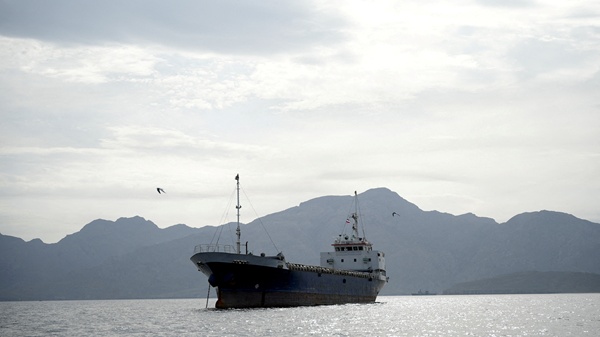
 A vessel in the Strait of Hormuz, off the coast of Oman’s Musandam province, 12 April 2026;
Credit: Reuters/File Photo
A vessel in the Strait of Hormuz, off the coast of Oman’s Musandam province, 12 April 2026;
Credit: Reuters/File Photo
DUBAI/WASHINGTON (Reuters) - On Wednesday 15 April 2026, the United States (US) said its military had completely halted trade going in and out of Iran by sea, while President Donald Trump said talks with Tehran on ending the war could resume this week, sending oil prices down for a second day.
Trump said negotiations between US and Iranian officials could resume in Pakistan in the next two days and Vice President JD Vance, who led weekend talks that ended without a breakthrough, said he felt positive about where things stood.
"I think you’re going to be watching an amazing two days ahead," Trump told ABC News reporter Jonathan Karl, adding he did not think it would be necessary to extend a two-week ceasefire that ends on Tuesday 21 April 2026.
"It could end either way, but I think a deal is preferable because then they can rebuild," Trump said, according to a post by Karl on X. "They really do have a different regime now. No matter what, we took out the radicals."
Officials from Pakistan, Iran and the Gulf also said negotiating teams from the US and Iran could return to Pakistan later this week, although one senior Iranian source said no date had been set.
Despite the optimistic note, more vessels were being turned back under the US blockade on Iranian ports, including a US-sanctioned and Chinese-owned tanker Rich Starry that was making its way back to the Strait of Hormuz on Wednesday after exiting the Persian Gulf.
Admiral Brad Cooper, the head of the US Central Command, said American forces had completely halted economic trade going in and out of Iran by sea, which he said fuels 90% of Iran's economy.
"In less than 36 hours since the blockade was implemented, U.S. forces have completely halted economic trade going into and out of Iran by sea," Cooper said in a post on X.
Earlier the US military said it had intercepted eight Iran-linked oil tankers since the start of the blockade on Monday 13 April 2026, according to the Wall Street Journal.
Return to Islamabad
Trump, speaking to the New York Post on Tuesday, said his negotiators are likely to be back, thanks largely to the "great job" Pakistan's army chief, Field Marshal Asim Munir, was doing to moderate the talks.
Later on Tuesday, at an event in Georgia, US Vice President JD Vance said Trump wanted to make a "grand bargain" with Iran but there was a lot of mistrust between the two countries. "You are not going to solve that problem overnight," he said.
The signs of diplomatic engagement to end the conflict that began on 28 February 2026 helped calm oil markets, pressing benchmark prices below $100 for a second day on Wednesday. Asian stocks rose while the safe-haven dollar stabilised after falling for a seventh straight session overnight.
However, the market stands to lose access to further supply as the US does not plan to renew a 30-day waiver of sanctions on Iranian oil at sea that expires this week, according to two US officials, and quietly let a similar waiver on Russian oil run out on the weekend.
The war has prompted Iran to effectively shut the Strait of Hormuz, a crucial global waterway for crude and gas transport, and cut shipments from the Gulf to global buyers, particularly in Asia and Europe, leaving importers scrambling to secure alternate supplies.
About 5,000 people have died in the hostilities, including about 3,000 in Iran and 2,000 in Lebanon.
Sticking Points
Iran's nuclear ambitions were a key sticking point at the weekend talks. The US had proposed a 20-year suspension of all nuclear activity by Iran, while Tehran had suggested a halt of three to five years, according to people familiar with the proposals.
Speaking in Seoul, the head of the International Atomic Energy Agency (IAEA), Rafael Grossi, said the length of any moratorium on Iranian uranium enrichment was a political decision and it was possible Tehran might accept a compromise as a confidence-building act.
The US has also pressed for any enriched nuclear material to be removed from Iran, while Tehran has demanded that international sanctions against it be removed.
One source involved in the negotiations in Pakistan said back-channel talks since the weekend had produced progress in closing that gap, bringing the two sides closer to a deal that could be put forward at a new round of talks.
However, in a major complication for peace prospects, Israel has continued to attack Lebanon as it targets Hezbollah, an Iran-backed militant group. Israel and the US say that campaign is not covered by the ceasefire, while Iran insists it is.
On Tuesday, the UK, Canada, Japan and seven other countries condemned the killings of UN peacekeepers in Lebanon and called for "an urgent end to hostilities".
The statement comes after the deaths of three Indonesian peacekeepers last month. The countries welcomed the ceasefire agreed between the US, Israel and Iran.