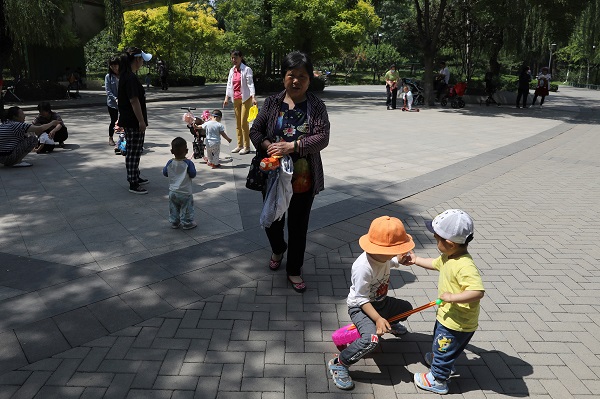
 Children play next to adults at a park in Beijing, China, 1 June 2021;
Credit: Reuters / Tingshu Wang
Children play next to adults at a park in Beijing, China, 1 June 2021;
Credit: Reuters / Tingshu Wang
BEIJING (Reuters) - Beijing will include more than a dozen fertility services in a government-backed medical insurance scheme for the Chinese capital, state media reported on Monday 21 February 2022, supporting those seeking to have babies with China's birth rate at a record low.
A total of sixteen medical services using assisted reproductive technologies (ART) will be covered by the city's state insurance effective from 26 March 2022, in a move to "take proactive fertility support measures", according to the Beijing Daily.
The new reproductive coverage could help lower out-of-pocket costs and benefit couples in lower income brackets seeking to have babies and those with little or no access to private medical insurance.
Official data showed China's birth rate dropped to a record low in 2021, extending a downward trend that led the national government last year to begin allowing couples to have up to three children.
China will work towards achieving an "appropriate" birth rate, Premier Li Keqiang said at the start of the annual parliamentary meeting in March last year.
China faces what experts call a "demographic time-bomb" as its elderly population increases while its workforce gets smaller due to decreasing births, partly due to a one-child policy in place for about four decades before being scrapped in 2016.
China will raise the statutory retirement age "in a phased manner", Li Keqiang said last year.
The eastern province of Jiangsu said last month that starting from March, employees eligible for state pensions will be able to apply for delayed retirement for no less than one year from the statutory retirement age.